
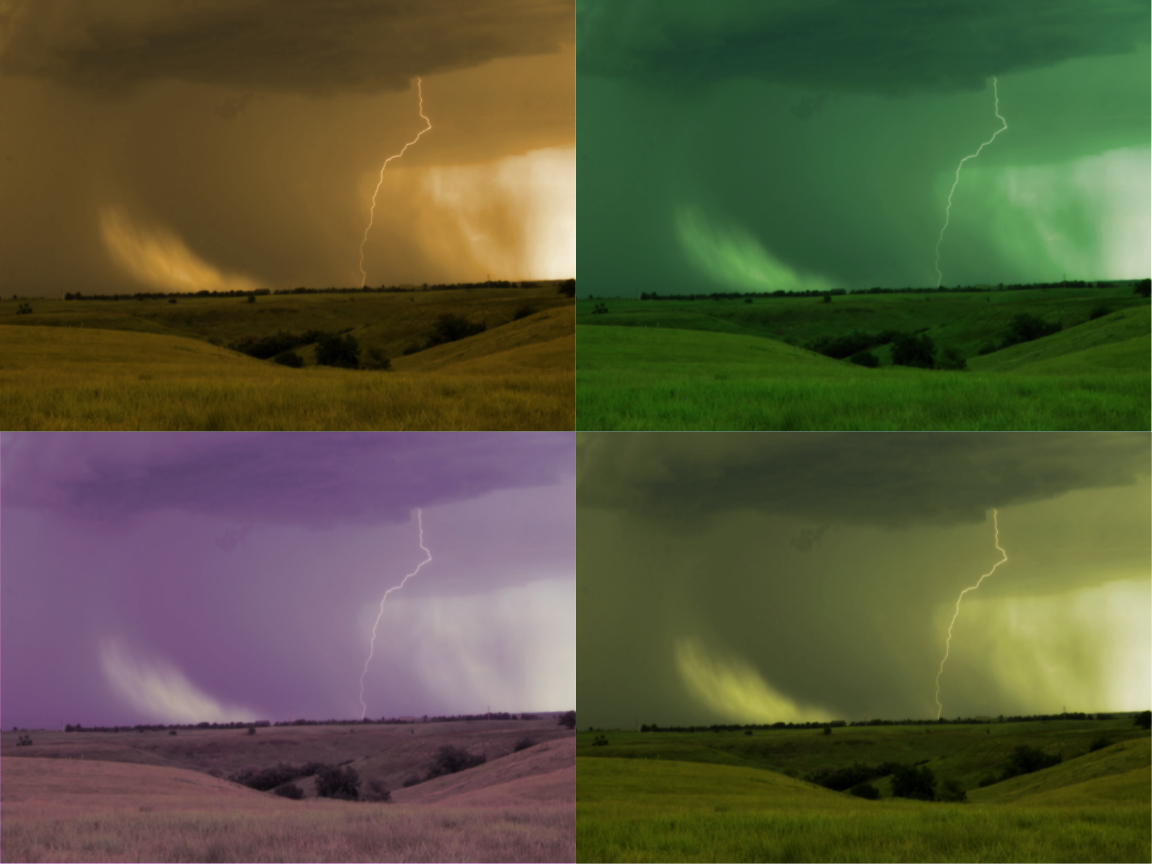

Growing up in tornado alley, I’ve always noticed something strange about thunderstorms. A few years ago, a severe thunderstorm hit my hometown, and a tornado made a rampage through some areas near me. My mother and I had to take cover in the back of a men’s clothing store while the twister tore up powerlines and apartments on the other side of the road. It took us over an hour to take the usually 15 minute drive back to our home, and sometimes we couldn’t even tell if we were driving on the right side of the road. In the direct aftermath of the storm, I observed that the air around me appeared as a dusky sepia color.
Severe thunderstorms can often have this effect on the color of the atmosphere, turning it sepia/brown, fiery orange, dusty yellow, blueish green, or even (in some rare cases) pink/purple. For example, a few months ago on June 12, 2026, Milwaukee residents found the sky and air around them to be an alien pink after storms had passed their area (La Roche, 2026). However, why exactly does this phenomenon happen? What unique abilities do storms possess to change the color of the world around us?
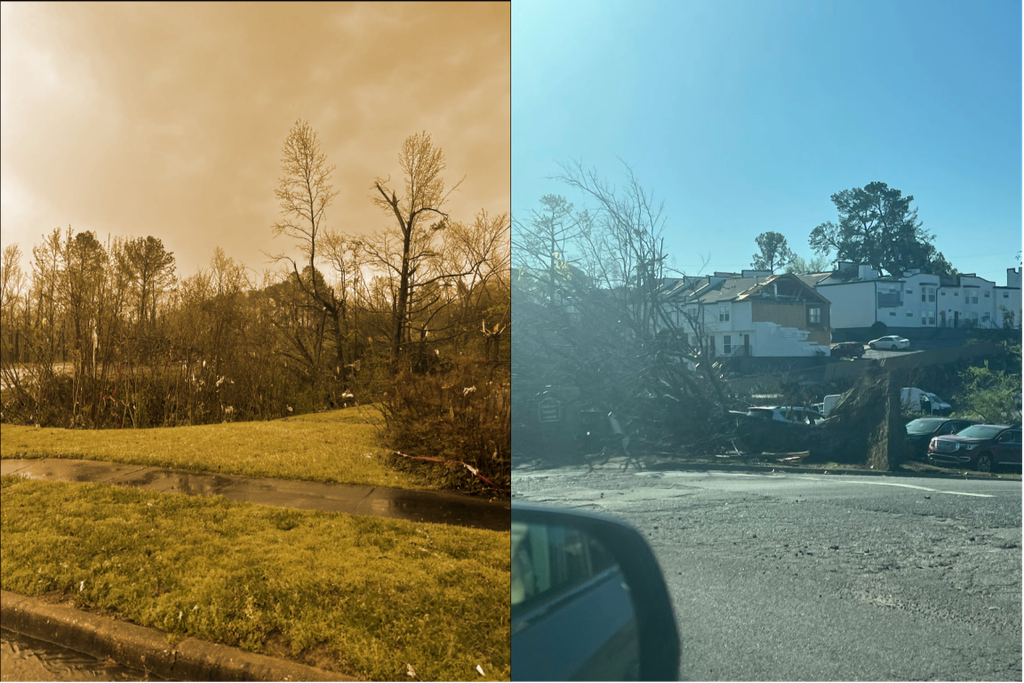
Photos taken by me showing one hour compared to one day after my city’s storm.
To answer this question, we must first learn how the sky usually attains its normal color. The light the Sun emits upon the Earth is white, hence it contains all color wavelengths from the longest red and yellow waves to the shortest blue and violet waves. When sunlight reaches Earth’s atmosphere, it hits mostly the nitrogen and oxygen gases found there. Because blue light is on the shorter end of the wavelength scale, it bounces off these air molecules and spreads out across the sky much more easily than red or yellow light. This process is known as Rayleigh scattering, and it is why our sky is usually blue. It’s not purple because the Sun radiates much less violet light compared to blue light, and human eyes are also far more sensitive to blue (Wallace & Hobbs, 2011).
Additionally, the sky is red, orange, and yellow at sunsets and sunrises because as the Sun rises above or escapes below the horizon, its light has to travel through much more of the atmosphere to reach your vantage point. Due to the increase in air molecules the light traverses through, most of the blue light ends up scattering away before it gets to you, leaving only longer wavelengths (Wallace & Hobbs, 2011).
However, the sky is not always clear and blue. What happens when there are discrepancies in the atmosphere? When there are particles in the air such as dust or water particles that are roughly larger than or comparable to the size of the wavelength of light, a process called Mie scattering occurs. This process causes all visible wavelengths of light (not just blue) to “scatter” mostly in the direction the light is already traveling. This results in clouds appearing white and the atmosphere seeming less vibrant on foggy days. Additionally, thicker clouds block and scatter sunlight excessively causing very little light to escape from the bottom. This casts a heavy shadow that makes the cloud look dark gray or black (Potter & Simmons, 2021).
Now let’s observe cases of the sky during storms. Severe storms cause a greater amount of particles to reside in the atmosphere (thicker clouds contain rain and hail, dust particles get kicked up into the atmosphere, etc.). As a result, greater deviations from the Rayleigh and Mie scattering models occur, resulting in colors different from blue, white, and dark gray. One example of scattering variance is as follows. Thunderstorms often occur early or late in the day when red and yellow sunlight dominate. When this light passes through both the atmosphere and massive storm clouds containing water and large hail, it interacts with blue light scattered there. When this red-yellow light illuminates blue light, it can produce a greenish tint, causing the surrounding area to appear green (Bohren & Fraser, 1993). In another case when sunrise or sunset light passes through dust, soil, smoke, or other pollution particles stirred up by storms, this light is scattered to create a dusky sepia atmosphere (Lynch & Livingston, 2001).
As a result, we find that severe storms change the color of the sky through their impact on sunlight scattering. Far from an alien anomaly, these surreal color shifts reveal how thunderstorm dynamics can temporarily rewrite the optical rules of our atmosphere, turning a simple blue sky into a vivid canvas of extreme weather.
References
Bohren, C. F., & Fraser, A. B. (1993). Green Thunderstorms. Bulletin of the American Meteorological Society, 74(11), 2185-2194. https://doi.org/10.1175/1520-0477(1993)074%3C2185:GT%3E2.0.CO;2
La Roche, M. (2026). What caused the pink sky after storms passed southern Wisconsin. WISN. https://www.wisn.com/article/what-caused-the-pink-sky-after-storms-passed-southern-wisconsin/71572555
Lynch, D. K., & Livingston, W. C. (2001). Color and Light in Nature (2nd ed.). Cambridge University Press. https://doi.org/10.1002/col.5080210510
Potter, K. S., & Simmons, J. H. (2021). Optical properties of insulators—Fundamentals. Optical Materials, 101–171. https://doi.org/10.1016/b978-0-12-818642-8.00003-x
Wallace, J. M., & Hobbs, P. V. (2011). Atmospheric Science: An Introductory Survey (2nd ed.). Elsevier Academic Press. https://www.sciencedirect.com/book/monograph/9780127329512/atmospheric-science
