

Consider the following word:
You most likely read this word very easily.
You didn’t have to be told what the word meant, your brain understood it almost instantly. However, once you know how to read it can be quite challenging to look at the word and not try to read it.
But what if…
Someone were to disrupt your reading?
This doesn’t involve putting something over your eyes or changing the letters. They simply tell you to experience the words differently.
This idea has been looked into by scientists using hypnosis.
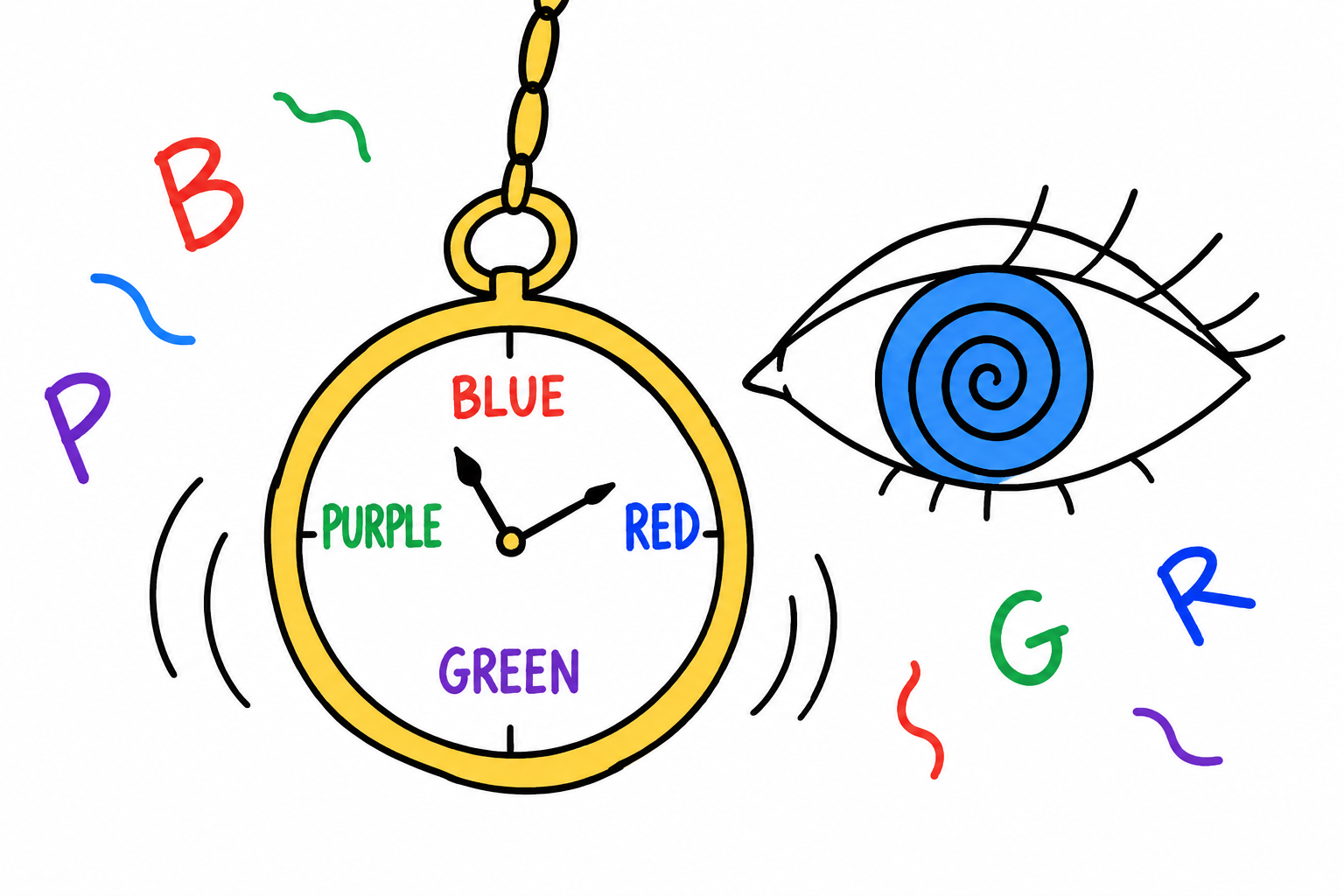
When you hear hypnosis you may imagine someone using a pocket watch to put a patient into a trance or even a performer making their audience act like a monkey! However, people have looked into interesting topics about how our brains can be affected by verbal suggestions using hypnosis.
It appears that reading isn’t always as easy as we think!
Your brain may argue with you
Try to say the color of the ink in each word (reading from left to right) as fast and accurate as possible.
This was quite easy. Try again with this set.
Why was this harder?
Perhaps you hesitated while answering. You may have almost said blue instead of red. You knew what the answer was but the word was interfering.
This type of interference is known as the Stroop effect. We are so quick to read familiar words that our brain is competing for our attention between knowing what the word means and what color it is. Generally people will answer slower when they are given conflicting information (Raz et al., 2005).
Because the task was so short, you may not have noticed much of a difference. This simply aims to show you an example of interference.
However, it does make you wonder, could someone make the word stop interfering?
In a study from 2005 by Amir Raz, Jin Fan & Michael Posner they looked into this. Participants were given a post hypnotic suggestion to tell them to view the words as meaningless symbols.
As if you were reading a language you don’t understand.
The suggestion significantly reduced the interference in highly hypnotisable participants. Brain scans showed there was less activation in the anterior cingulate cortex, which plays a role in monitoring conflict in the brain (Raz et al., 2005).
While they weren’t taking away people’s ability to read, the suggestion helped to reduce interference from the words. The letters remained the same but the suggestion helped.
What is happening in the brain?
Heidi Jiang and colleagues looked into this using fMRI. This allows us to see how the brain is working by looking at changes in oxygenation of blood.
They looked at people who were highly hypnotisable and those who were not. They found there were changes in several areas of the brain during hypnosis (Jiang et al., 2017).
Lots of brain areas with a strange experience
The dorsolateral prefrontal cortex (DLPFC) helps to control attention and behavior. The insula helps with processing internal body sensations. These two areas were more correlated during hypnosis.
There was less activation in the dorsal anterior cingulate cortex (dACC) which plays a role in attention and monitoring conflicting demands.
They also found less coordination between the DLPFC and posterior cingulate cortex (PCC), which plays a role in self-related thoughts (Jiang et al., 2017).
There are a lot of areas mentioned here but what is important is how they worked together.
Connectivity refers to how correlated the activation patterns were. This doesn’t mean new connections were formed in the brain. Overall, this suggests that different systems in our brains involved in attention, body awareness and self-related thoughts are interacting differently.
Your brain is still very active but some of the correlations between your brain activity can change.
However, there are limitations to this. The effects shown in the reading experiment were for highly hypnotisable people. Neither study showed that someone could control all their thoughts and behaviors. The brain scan also cannot tell us that everyone will experience hypnosis in the same way.
However, it is interesting to know that something like reading can be influenced by a suggestion. The words can still be there but the interference from them can be lessened.
Going back to the colored words.
You most likely still wanted to read them. Imagine being told to view them as just shapes for a moment and actually seeing a difference.
How much more flexible are our automatic behaviors?
References
Jiang, H., White, M. P., Greicius, M. D., Waelde, L. C., & Spiegel, D. (2017). Brain activity and functional connectivity associated with hypnosis. Cerebral Cortex, 27(8), 4083-4093. https://doi.org/10.1093/cercor/bhw220
Raz, A., Fan, J., & Posner, M. I. (2005). Hypnotic suggestion reduces conflict in the human brain. Proceedings of the National Academy of Sciences, 102(28), 9978-9983. https://doi.org/10.1073/pnas.0503064102
