
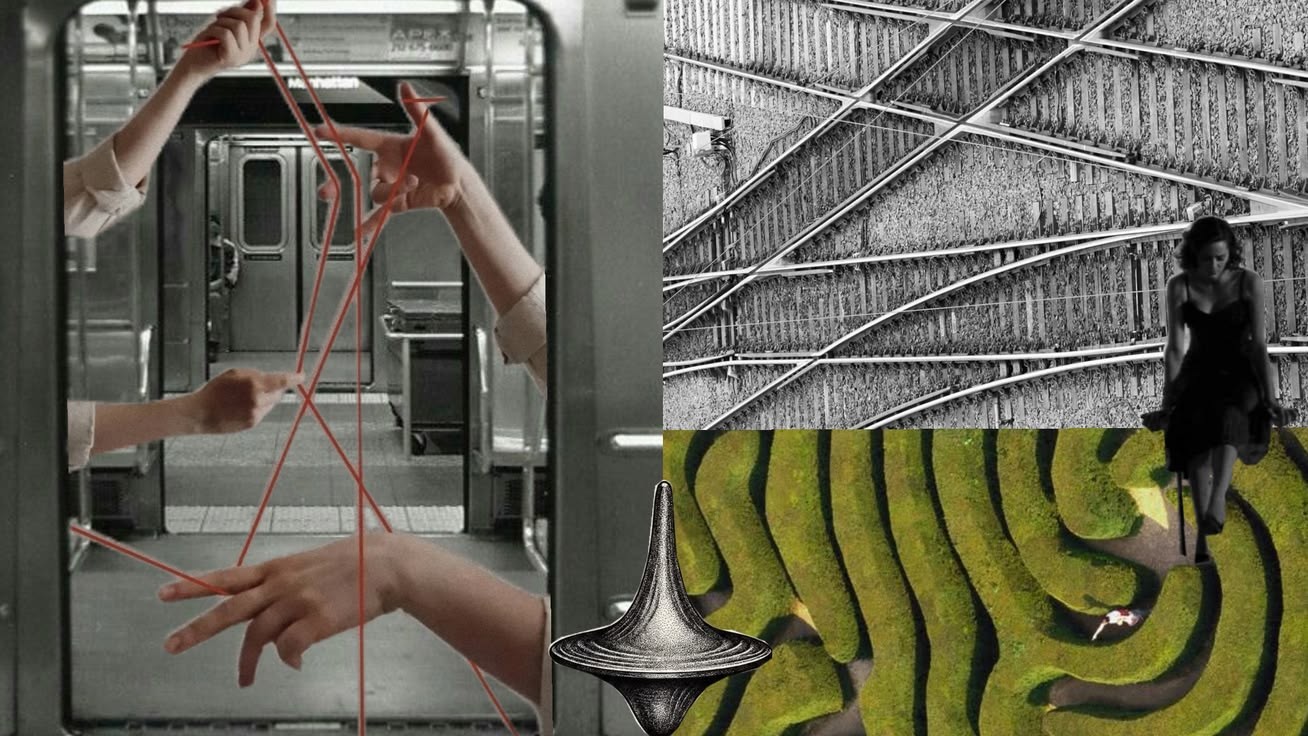

Warning: read with caution if you don’t want spoilers for the movie Inception!
Comedian, actress, and podcaster Mary Beth Barone has a theory that Christopher Nolan’s real trilogy is not The Dark Night (Nolan, 2005-2012) movies. Instead, she proposes Interstellar (Nolan, 2014), Oppenheimer (Nolan, 2023), and Inception (Nolan, 2010) because they all answer the same question: what is the most powerful thing in the universe? She claims that Interstellar is about how love is the most powerful thing in the universe, Oppenheimer is about how a nuclear bomb is the most powerful thing in the universe, and Inception is about how an idea is the most powerful thing in the universe.
Inception is based on the phenomenon of lucid dreaming in which the dreamer is aware of the fact they are dreaming while still in the dream state. Lucid dreamers are sometimes able to exert control over their dreams “including the environment, narrative, other dream characters and their own actions” (Bonamino & Peters, 2026). Nolan’s film takes this ability to the next level.
In Inception, Dom Cobb (played by Leonardo DiCaprio) leads a team of professional thieves who use dream-sharing technology to steal secrets from high-powered individuals. In order to conduct their corporate espionage, they enter a chemically induced state of lucid dreaming and design the dreams to engineer scenarios which expose the information they seek. After a successful operation, they are hired by their target to go beyond simply extracting information from a business rival to actually implanting an idea in his mind – a process known as inception. In order to convince the new target, Robert Fischer (played by Cillian Murphy), that the idea is his own, they devise a plan to obscure it using three layers of abstraction. In other words, they implant it in a dream within a dream within a dream.
The dream sharing technology that Cobb’s team uses doesn’t actually exist, but researchers have been looking into developing methods to chemically induce lucid dreaming for academic and therapeutic reasons. While nothing has been proven yet, there are correlations between lucid dreaming and taking drugs like melatonin, LSD, and donepezil (Baird et al., 2019). Non drug methods in which the dreamer is woken up during REM sleep and waits an allotted amount of time before attempting to consciously re-enter their dream have also been correlated with lucid dreaming. Being able to induce lucid dreaming is thought by psychologists, neuroscientists, psychiatrists to be a way to learn more about brain function and mental health.
Although we don’t yet have the ability to induce lucid dreams, it is possible to detect when someone is in a lucid dream while they sleep. Before sleep monitoring, the sleeper and observer agree on a signal to indicate when the sleeper realizes they are in a dream. Commonly, the signal is a series of eye movements which the dreamer can execute within the dream and the observer can see in the eye movement monitoring that detects REM sleep (Baird et al., 2019). This objectively verifiable technique has been implemented since the 1970s.
In Inception, one of the reasons for implanting the idea in such a deep dream layer is to avoid any suspicion from the target that the thoughts may not be his own. Sleep paralysis, which is associated with REM sleep and shares many similarities with lucid dreaming, is frequently accompanied by hallucinations. There are three categories into which these hallucinations are classified: incubus, vestibular-motor, and intruder. With incubus hallucinations, the individual may feel like they can’t breathe due to strangulation, choking, or pressure on the chest. Vestibular-motor hallucinations can cause the individual to feel like they’re flying, falling, or even having an out-of-body experience (Ableidinger & Holzinger, 2023). Intruder hallucinations aptly describe the sense that another (usually malicious or suspect) person is present. In Inception, preventing the target from perceiving Cobb’s team as intruders is integral to their mission. Intruder hallucinations, in addition to the other categories of sleep paralysis hallucinations, commonly evoke emotions of fear and anxiety. Within Inception, any inkling of those emotions or the feeling of an intruder on the target’s behalf would shatter the illusion and cause the mission to fail. Hence, the need for several layers of abstraction.
In the movie, the multilayer strategy presents a myriad of logistical challenges including waking up from multiple dream levels. To do this, the team plans multiple “kicks” in each dream layer which wake them up by giving them the feeling of falling. While many aspects of the movie are purely science fiction, the idea of a “kick” as a tool to trigger waking is rooted in science. During REM sleep, the body experiences muscle atonia in order to prevent the dreamer from acting out the dream and hurting themself in the real world. While most sensory stimuli experienced during REM sleep can be subconsciously integrated into the dream scenario, the essence of the stimulus, like mortal danger, persists (Coenen, 2024). In the world of Inception, a simple “kick” would be suddenly tipping back the chair the dreamer was sitting in during the operation to wake them from the scenario.
In the film, the distinction between artificially constructed dream scenarios and real life is known to become increasingly blurred. For this reason, each member of Cobb’s team carries a totem: a weighted item with unique properties known only to their owner. When one of the team members needs to confirm whether or not they are in a dream or reality, they use their totem as a litmus test. Since the totem’s owner is the only person who knows the item’s unique properties, if they were in someone else’s dream, the totem would not feel or behave as it should. For example, one member of the team uses a weighted die which always lands on one undisclosed number in reality, but would behave like any other die (fair or unfair) in someone else’s dream. Since the inception technique requires multiple dream layers, it is imperative for the members to objectively assess reality. Even in regular lucid dreams, a dreamer can experience false awakenings in which they think they’ve woken up in reality, but discover that they are in fact still dreaming. A common type of reality check in these scenarios is testing impossibilities. For example, being able to stick a finger through your own hand.
By the end of the movie, the line between dream and reality is constantly in question and the characters have made drastic decisions based on the state they perceived themselves to be in. This is partly why the mission to achieve inception succeeds, proving that an idea truly is the most powerful thing in the universe.
References
Ableidinger, S., & Holzinger, B. (2023). Sleep paralysis and lucid dreaming—between waking and dreaming: A review about two extraordinary states. Journal of Clinical Medicine, 12(10), 3437. https://doi.org/10.3390/jcm12103437Baird,
B., Mota-Rolim, S. A., & Dresler, M. (2019, March 23). The cognitive neuroscience of Lucid dreaming – sciencedirect. Science Direct. https://www.sciencedirect.com/science/article/abs/pii/S0149763418303361
Bonamino, C., & Peters, E. (2026). Lucid dream control: Mechanisms, challenges and future directions. Journal of Sleep Research. https://doi.org/10.1111/jsr.70449
Coenen, A. (2024). Sensory gating and gaining in sleep: the balance between the protection of sleep and the safeness of life (a review). Journal of Sleep Research, 33(5), e14152. https://doi.org/10.1111/jsr.14152
