


A trip to the gas station: what is fueling your car?
I remember going to the gas station with my parents a few years ago and walking around a bit. After turning a corner, I saw a sunflower growing from a crack in the pavement. I was instantly reminded of how cellulose, an organic polymer compound that makes up plant cell walls, is being studied as a fuel alternative. Today, most people put gasoline in their cars. Gasoline is a mixture predominantly made of hydrocarbons (molecules made up of carbon and hydrogen atoms) such as alkanes, isoalkanes, and aromatics. It also contains a smaller amount of ethanol and fuel additives (Ritter, 2023).
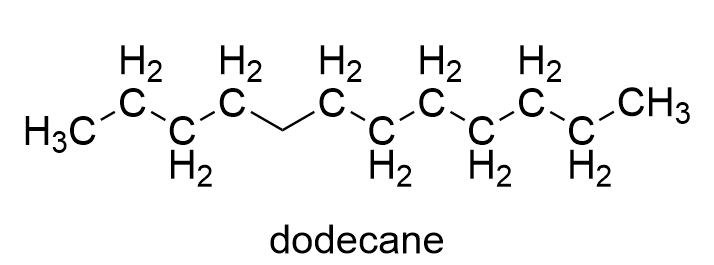
- Linear alkanes: Long, linear carbon backbone. Dodecane is just one type of alkane found in gasoline:
- Isoalkane: Similar to linear alkanes. Instead of one long chain of carbons, this molecule has branches of carbon chains. Isooctane is a type of isoalkane found in gasoline:
- Aromatic: Cyclic, flat structure. An example of an aromatic found in gasoline is benzene:
This fuel is derived from crude oil, a liquid fossil fuel found deep underground or closer to the surface in oil sands (Turgeon, 2023). The kicker behind fossil fuels is that they are non-renewable, meaning that they take much longer to form compared to the speed at which they are being used. To put it in perspective: petroleum takes between 1 and 10 million years to form under specific conditions, while 38 billion barrels were extracted and consumed in 2025 (WorldOmeter). In an effort to reduce the demand for petroleum, scientists have turned to cellulose as a potential source of energy.
What are biofuels, and how are they incorporated into the fuel industry?
A biofuel close to commercial use is cellulosic ethanol. Currently, fuel-grade ethanol is added to gasoline to increase the octane rating (stability), promote cleaner combustion, and reduce air pollution (EIA, 2016). It is mostly produced from food-based plant products (1G) such as corn and sugarcane (Qamar, 2020). These are processed, fermented with yeast, then distilled and dehydrated to produce fuel-grade ethanol. A downside to this process is the use of food crops for fuel production, diverting resources away from the global food supply. Newer methods of deriving ethanol from alternative sources are under study. To convert non-food crops (NFC) (such as sawdust and switchgrass) into ethanol, a few processing steps are required. First, raw material is treated with chemicals or mechanically broken down via milling and grinding to increase the working surface area (Sedlak, 2004). This exposes cellulose from the material, making the next processing step possible. Next, special enzymes or acids are used to break down cellulose into smaller sugars that are easily fermentable. This process can be compared with how some herbivores are able to digest cellulose. These animals have a symbiotic relationship with microbes in their gut that break down cellulose into smaller, digestible components. Engineered yeast or bacteria are employed to ferment the resulting mixture of sugars. This is similar to how yeast fermentation in bread making converts one substance (sugars and starches) into other substances (carbon dioxide and ethanol). The resulting mixture is distilled and dehydrated into fuel-grade ethanol (Sedlak, 2004).
What goes into scaling biofuels for commercial use?
Biofuel alternatives are present and available. The next step is to scale up production to allow for commercial use. Why are 1G sources cheaper than NFC sources to produce fuel-grade ethanol? Both contain cellulose, while only NFC sources contain a rigid polymer called lignin. Lignin is the troublemaker that drives the cost of production up. In these materials, lignin is tightly bound to cellulose (Hines, 2016). Additional pretreatment steps that separate lignin from cellulose are required. Current research is working toward optimizing pretreatment and finding novel organisms or engineering current microbes to break down cellulose (Kumar, 2013; Sedlak, 2004).
Conclusions
Research is ongoing to improve the production of cellulosic ethanol. These efforts, combined with other efforts to produce biofuels, will help reduce the rate at which petroleum is extracted from the Earth. Biofuels might one day replace traditional fuels for personal vehicles!
References:
Ritter, S. K. (2023). Gasoline. Chemical & Engineering News; American Chemical Society. https://cen.acs.org/articles/83/i8/GASOLINE.html
Turgeon, A., & Morse, E. (2023). Petroleum | National Geographic Society. Education.Nationalgeographic.Org; National Geographic. https://education.nationalgeographic.org/resource/petroleum/
WorldOmeter. (2016). World oil statistics – worldometer. Www.Worldometers.Info. https://www.worldometers.info/oil/
U.S. Energy Information Administration. (2016). Gasoline explained – U.S. Energy Information Administration (EIA). Eia.Gov. https://www.eia.gov/energyexplained/gasoline/
Sedlak, M., & Ho, N. W. Y. (2004). Production of ethanol from cellulosic biomass hydrolysates using genetically engineered saccharomyces yeast capable of cofermenting glucose and xylose. Applied Biochemistry and Biotechnology, 114(1–3), 403–416. https://doi.org/10.1385/abab:114:1-3:403
Qamar, S. Z., & Al-Kindi, M. (2020). Renewability and sustainability: Current status and future prospects. In Encyclopedia of renewable and sustainable materials (Vols. 1–5, pp. 717–730). Elsevier.
Kumar, D., & Murthy, G. S. (2013). Stochastic molecular model of enzymatic hydrolysis of cellulose for ethanol production. Biotechnology for Biofuels, 6(1), 63. https://doi.org/10.1186/1754-6834-6-63
Hines, J. (2016, February 16). Biofuel researchers employ titan to probe ‘lignin shield’. Ornl.Gov. https://www.olcf.ornl.gov/2016/02/16/biofuel-researchers-employ-titan-to-probe-lignin-shield/