
My Little Observation
On October 10, 2026, Hurricane Isaias passed by Georgia. Even though the hurricane didn’t directly hit the region, heavy rains and strong winds are observed. By the time I stepped outside, there wasn’t any ray of sunlight. It was so gloomy and chilly. Even the clear stream behind my house became muddy and the flow was more aggressive. That reminded me about the heartbreaking news of Nepal flooding back in August.
Even for those that rarely follow the news, they would at least hear a thing or two about the Nepal flooding. Though all natural disasters are equally the worst thing to happen, in terms of casualties, it was one of the worst occurrences in recent years. Researchers say the origin of the flooding comes from part of the Himalayas, a famous natural wonder housing Everest – the “Highest Peak” on Earth. As beautifully breathtaking as it is, Himalayas can also be as helpful and deadly as it can.
The “Third Pole” and Its Place in Human Society
Did you know that glaciers are the source of nearly two-thirds of the world’s freshwater, naming itself the largest natural solid reservoirs? The Himalayas are home to the largest glaciers outside of the polar regions (Shrestha et al., 2025). The area that encompasses the Hindu Kush Himalaya mountain range and the Tibetan Plateau is also known as The “Third Pole” (Sabin et al., 2020). As the name suggests, this area reserves the third largest source of freshwater aside from the Arctic (north) and Antarctica (south).
The Himalayas support ten major river systems. It provides water for drinking, irrigation and power for over 1.3 billion people across 8 countries in Asia, which is approximately 20% of the world’s population (Sabin et al., 2020). Glaciers are a critical source of supplying water for local populations and the agricultural irrigation, especially to the downstream areas (Sun et al., 2026).
However, downstream areas often face risk of flooding. In recent decades, most outburst flooding has been the effect of glacier response to climate warming, with the Nepal tragedy being the most recent major issue. Flooding has become the most frequent environmental hazard, annually claiming over 20,000 lives and impacting approximately 75 million individuals worldwide (Malla & Ohgushi, 2026). As a result, there was an increase in research about global glacier melting and its effect on human society.
Glacier Melting – Causes and Consequences
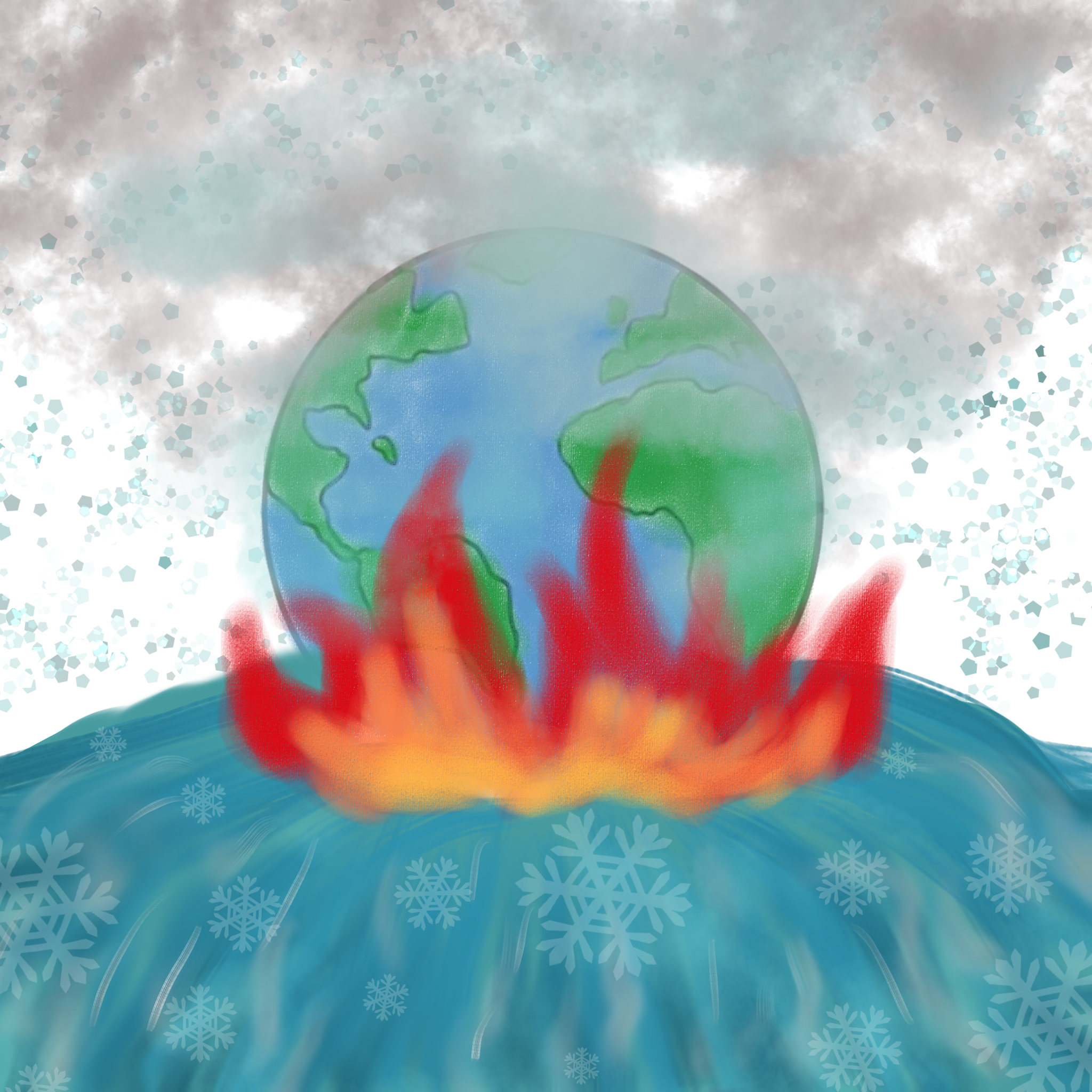
One of the most significant indicators of global climate change is the glacier melting. According to Liu et al. (2026), local factors including but not limited to “solar radiation, geothermal effects and the albedo effect also play important roles” in this process. However, the study also emphasizes that glacier melting is mainly driven by rising global temperatures. As a matter of fact, as the temperature rises and less glaciers become available, the melting process only keeps accelerating.
The first to be affected are the local population living by water areas. Peak runoff – the water from the glacier retreats reaching its maximum runoff, has a major effect on water regulations such as climate regulation, freshwater supply, and hydroelectric power (Sun et al, 2026). For instance, the “value of glacier meltwater in regulating river runoff accounts for approximately 60% of the total, reaching up to 80%” in the Kaidu River Basin (Sun et al, 2026). With the runoff having an essential role in supporting domestic water supply, it’s not hard to imagine what happens when this water source overflows.
Perhaps, the final answer is a flood, just like the Nepal tragedy. According to Malla and Ohgushi (2026), “flooding is the most frequent environmental hazard, annually claiming over 20,000 lives and impacting approximately 75 million individuals worldwide.” As glaciers continue to melt at accelerating rates, regions that depend on glacier water systems have become important case studies to understand the consequences of climate change.
This trend can be observed on the Himalayas. According to a recent assessment by the International Centre for Integrated Mountain Development (ICIMOD) – a Himalayan research non-profit, “Nepal’s glaciers are melting twice as fast today as they were only 20 years ago” (Ayers, 2026). Furthermore, about 13% glaciers on the 20,060 km squared area of Himalayas might have been lost in the last four decades (Sabin et al., 2020). These findings support the conclusion of accelerating melting glaciers.
However, the glacier melting effect extends far beyond the Himalayas. Occasionally, one would come across news about melting glaciers at the poles, endangering the living habitats of pole-native animals. From my experience, these news, unfortunately, have come to the public’s eyes more frequently in the past few years. Liu et al. (2026) also noted that the accelerated melting glaciers contribute to rising sea levels, which threaten the survival of coastal populations. For instance, melting ice sheets from Greenland and Antarctica caused large amounts of freshwater to enter the ocean, disrupting the originally stable distribution of salinity and temperature (Liu et al., 2026). This disrupts and affects the North Atlantic Current, potentially causing a colder environment in Europe. Fortunately, it will not happen in just a few days.
Prediction by Scientists
As the consequences of glacier melting are already visible today, scientists expect the conditions to worsen throughout the twenty-first century. Using different climate projections, Sabin et al. (2020) suggest that warming of the Hindu Kush Himalayan region will fall in the range of 2.6 to 4.6 degree Celsius by the end of the century. Similarly, if temperatures remain rising, Sun et al. (2026) predicts that “glacier area and volume will decrease by more than 40% in most basins”. Likewise, Malla and Ohgushi (2026) project a significant increase in flood risk throughout all future periods, 2031-2050, 2051-2070, and 2071-2100. This result aligns with Ayers’s (2026) statement regarding Nepal flood: “as our climate continues to warm, these types of unthinkable, 1,000-year events will become more and more commonplace.” These studies suggest that glacier retreat will likely continue for decades. It’s likely that the future generations could face more frequent and extreme weather than we are today.
Afterthought
We are all but just ants getting swept away when facing such powerful natural disasters like flooding. One might be lucky enough to survive one, but who would want to face another or more. Flooding might have always been part of Earth’s climate, but it only became more frequent due to our advancing civilization and unconstrained use of “nature” without giving back. With advanced technology, we can predict, prepared for, and migrate the consequences of such situations. However, isn’t it better to prevent or limit it from happening? A thousand hands can make up a contribution, regardless if it was small or big. Whether it is recycling everyday objects, reducing unnecessary energy and emission consumption, or volunteering in environmental projects, every effort helps slow the effects of climate change.
References
Ayers, B. (2026, August 29). You have questions about the nepal floods. our Himalayan expert has answers. Outside. https://www.outsideonline.com/outdoor-adventure/exploration-survival/nepal-flood/
Liu, S., Li, Y., Xia, Y., Li, Y., Li, P., Wen, Z., Xie, M., Wang, Y., Wang, Z., Guan, C., & Zhang, P. (2026). How ice melts in nature: A comparative experimental study. Results in Engineering, 29, 109259. https://doi.org/10.1016/j.rineng.2026.109259
Malla, S., & Ohgushi, K. (2026). Comprehensive flood risk evaluation with climate change study for the Bagmati River basin in Nepal. Smart Construction and Sustainable Cities, 4(1). https://doi.org/10.1007/s44268-026-00097-7
Sabin, T. P., Krishnan, R., Vellore, R., Priya, P., Borgaonkar, H. P., Singh, B. B., & Sagar, A. (2020). Climate change over the Himalayas. Assessment of Climate Change over the Indian Region, 207–222. https://doi.org/10.1007/978-981-15-4327-2_11
Shrestha, M., Sharma, S., & Pradhan Shrestha, R. (2025). Landslides in the Himalayas: A comprehensive review of hazards, impacts, and adaptive strategies. Rural and Regional Development, 3(1), 10002–10002. https://doi.org/10.70322/rrd.2025.10002
Sun, J., Chang, J., Guo, A., Wang, Y., Li, Z., Zhai, D., Wang, P., & Wang, J. (2026). Climate warming-induced glacier mass loss driving peak runoff variability and cryosphere service value decline. Journal of Hydrology, 669, 135084. https://doi.org/10.1016/j.jhydrol.2026.135084
