

In my last article, I was talking about glacier melting due to climate change. Global warming is a big problem nowadays, leading to climate change and hence causing natural disasters simultaneously. Can we do something about this? Deforestation is one of the causes, so reforestation is one of the most obvious solutions. However, as individuals it’s a difficult task to achieve. Growing trees from seeds takes a long period of time. Only if it was as easy as duplicating instant tree objects as in games. Actually, we can clone trees in reality!
The Pando Aspen Grove
Have you heard about the Pando Aspen Grove? As of 2026, residing in Fishlake National Forest, Pando is believed to be the largest organism ever recorded at nearly 13 million pounds. According to the Forest Service – an agency of the U.S. Department of Agriculture, Pando clone currently spreads 106 acres, consisting of over 40,000 individual trees. They also defined Pando as an aspen clone that originated from a single seed and spreads by sending up new shoots from the expanding root system (Forest Service, 2026). However, how can all these trees possibly be parts of only one single organism?
In 2008, during a collaboration between Utah State University and USDA National Forest Genetics Laboratory, scientists used a DNA fingerprinting technique to confirm that the Pando clone was indeed a single genetic entity. In other words, as concluded by the research, “this enormous clone at some point in history emerged from a single seed about the size of a flea” (Utah State University, n.d.). This is the living proof of tree cloning and how much it possibly contributes to reforestation.
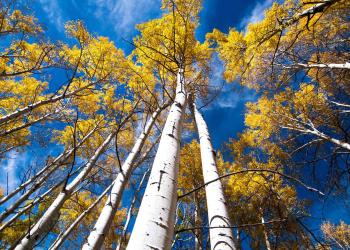
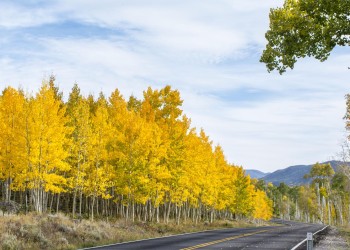
Images belong to Forest Service, retrieved at https://www.fs.usda.gov/r04/fishlake/recreation/explore-forest/pando
What is Tree Cloning?
In the book Multifunctional Agriculture – Achieiving Sustainable Development in Africa, the author Leakey defined tree cloning as “a process by which individual organisms are multiplied asexually – a process of vegetative regeneration or reproduction… Consequently, the individual plants forming a clone are genetically identical” (Leakey, 2017). In other words, with tree cloning, we don’t have to grow trees from seeds. Instead, by utilizing the “vegetative regeneration” ability, a new tree can be produced from part of an existing tree. This new tree is considered a clone and inherits the same characteristics of the parent tree. Regardless, tree cloning offers a rapid means of producing clonal planting stock for reforestation programs, mass production for high demand woods, and conservation of elite and rare germplasm (Giri et al., 2003).
Air Layering
One of the most common tree cloning techniques, even familiar to gardeners, is air layering. Air layering is often defined as “a form of asexual (vegetative) plant propagation in which roots are induced on a stem or branch while it remains attached to the parent plant” (Sarun, 2026). This method is usually applied to mature branches, which are capable of flowering and fruiting (Leakey, 2017). It is especially useful for woody plants that are difficult to reproduce from cuttings. As explained by Sarun (2026), air layering is effective for species such as litchi, citrus, and mango. This ties back to how air layering technique is effective on fruit trees to preserve the desirable traits as explained by Leakey.
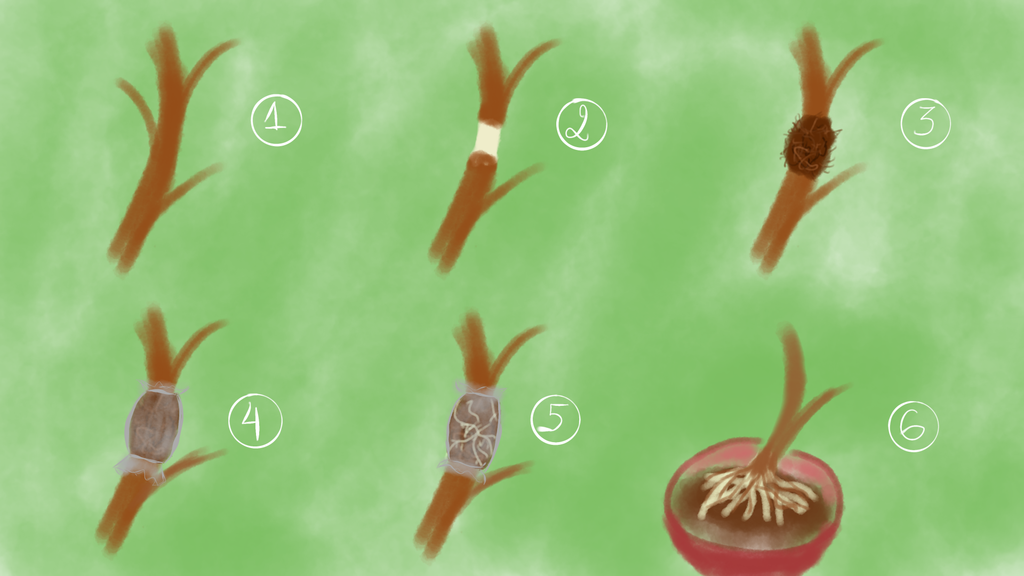
Here the steps by steps on how to air layer a plant (Seegalahalli, 2026):
- Choose a healthy branch
- Remove a ring of bark
- Apply most rooting medium (cocopeat or sphagnum moss) around the wounded area
- Wrap the wounded area securely with clear plastic and tie both ends
- Wait until roots develop
- Cut below the rooted area and plant it in a pot
In addition, air layering is not the only cloning technique in existence. Other forms of layering include simple layering, tip layering, serpentine layering, and mound layering (Sarun, 2016). These methods may be more effective than others for certain plant species than others, so the choice of cloning technique often depends on the characteristics of the plant itself.
Risks and Limitations
Even though the cloning tree method offers the benefit of saving time and preserving desirable characteristics, it also comes with risks and limitations. Clonal propagation is much more costly than conventional seedling, requiring special training and skillful laborers (Kumar, 2016). In addition, compared to micropropagation, clonal propagation has limited suitability for large-scale commercial production (Sarun, 2026).
Furthermore, clones replicate existing genetic traits from the parent tree without improving the genetic quality (Leakey, 2017). As a result, excessive reliance on cloning can reduce genetic diversity. According to Sniezko and Koch (2017), two USDA Forest Service staffs, “maintaining sufficient levels of genetic diversity in production populations will allow the species the best opportunity to continue to evolve and adapt to additional insect and disease outbreaks as they arise and even to novel environmental conditions brought about by a changing climate.” Because clones share the same genetics, they may be more vulnerable to new diseases and environmental changes. The latter is especially important with the inconsistent climate today.
Afterthought
Clonal propagation seems to be the ideal solution to support reforestation because it saves time and preserves ideal characteristics. However, the same traits can also make the clones weak against unpredictable environmental conditions as they are more vulnerable to new diseases. Therefore, tree cloning should be viewed as a starting point rather than a complete solution.
Even though clonal propagation saves time, reforestation still remains a long-term project that requires communities, researchers, and governments to join hands. Sniezko and Koch (2017) suggested the four major components to make this effort successful: “(1) research, (2) tree improvement, (3) planting, and (4) sustained management commitment.” A steady supply of resistant seeds, suitable lands, and continued management commitment are all necessary steps toward reforestation development and mitigating effects of climate change.
References
Fishlake National Forest – Pando. Forest Service. (2026, October 23). https://www.fs.usda.gov/r04/fishlake/recreation/explore-forest/pando
Giri, C. C., Shyamkumar, B., & Anjaneyulu, C. (2003). Progress in tissue culture, genetic transformation and applications of biotechnology to trees: An overview. Trees, 18(2), 115–135. https://doi.org/10.1007/s00468-003-0287-6
Kumar, V. (2016, January). Clonal forestry: Benefits and limitation (Technical Report 3(1), 26-29). Tropical Forest Research Institute. https://doi.org/10.13140/RG.2.1.2657.2889
Leakey, R. R. B. (2017). Plant cloning: Macro-propagation. Multifunctional Agriculture, 211–224. https://doi.org/10.1016/b978-0-12-805356-0.00020-9
Sarun, H. (2026). Layering Methods in Plant Propagation and Their Practical Importance. Journal of Agriculture and Environment, 3(3), 493–497. https://doi.org/10.5281/zenodo.19447134
Seegalahalli, N. (2026, June 17). How to air layer fruit plants: A simple propagation guide. BigHaat.com. https://www.bighaat.com/kisan-vedika/blogs/how-to-air-layer-fruit-plants?srsltid=AYCX9vK-BjJncRkedqR_IZad1ItoL-XYsfvSr_ghCQJiycA0PeU8_KmH
Sniezko, R. A., & Koch, J. (2017). Breeding trees resistant to insects and diseases: Putting theory into application. Biological Invasions, 19(11), 3377–3400. https://doi.org/10.1007/s10530-017-1482-5
U.S. Department of Agriculture. (2026b). Pando at Fishlake National Forest. Forest Service. Retrieved from https://www.fs.usda.gov/r04/fishlake/recreation/explore-forest/pando
Utah State University. (n.d.). Genetic issues and Pando: WAA. USU. https://qanr.usu.edu/western-aspen-alliance/pando/genetic
