
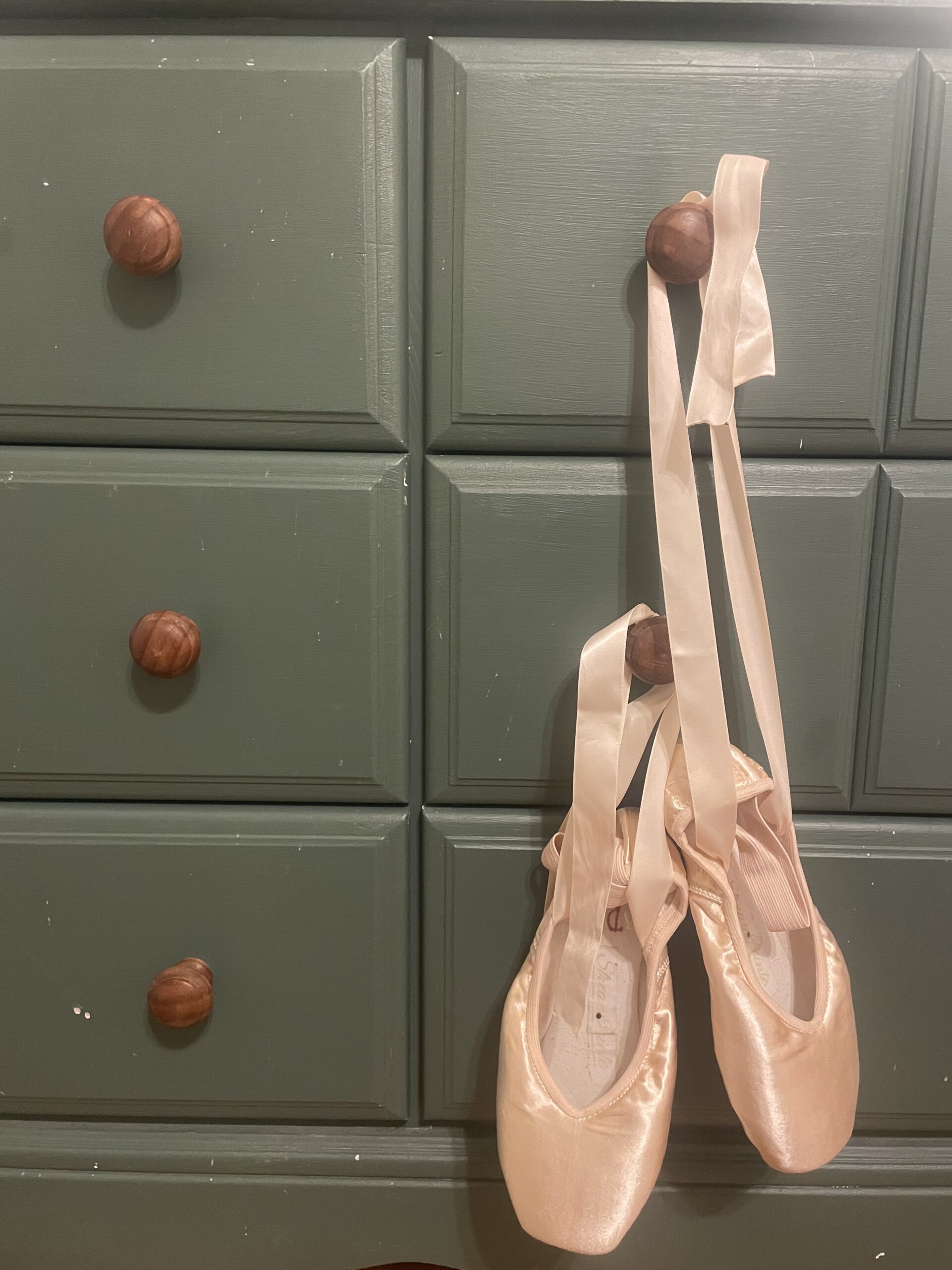

Ballet is for everyone — until the French terminology starts flying around and anyone unfamiliar with the art is left completely lost. Plié, grand battement, gargouillade. It is essentially the equivalent of a ballerina attempting to pronounce the names of complex molecular compounds. However, that does not mean all hope is lost for those who are more scientifically inclined. Beneath the elegant movements, elaborate French terminology, and beautiful performances lies a world of scientific principles deeply ingrained in the art of dance (Maheshwari et al., 2025).
BALANCE
Weight distribution is an important part of dancing. Although most dancers develop muscle memory through years of training, nearly every ballet position can be analyzed using a free-body diagram. Balance is one of the most fundamental skills required to succeed in ballet. This might sound intimidating if you immediately picture yourself standing on your toes with one leg extended behind you and a perfect smile on your face. However, building up to those quintessential ballerina poses takes time, strength, and an understanding of how the body moves. A good place to start is first position. In this position, the dancer stands with their heels together and toes turned outward, creating a stable starting point for many ballet movements.
Balance depends on the relationship between the body’s center of mass and its base of support. The body’s mass can be thought of as concentrated at its center of mass, while the base of support is the area beneath the body in contact with the floor. Maheshwari et al. (2025) explain that, for balance to be maintained in a stationary position, the body’s center of mass must remain within its base of support. This helps explain why balancing in second position is generally easier than in first position: because the feet are farther apart, the base of support is wider, allowing the center of mass to shift farther before balance is lost.
However, balance is about more than simply keeping the body upright; it also involves how the body responds when displaced from its original position. This brings us to the concept of stable equilibrium. A system is in stable equilibrium if it experiences a force or torque in the direction opposite its displacement (Beceiro-Novo, 2023). In ballet, consider a dancer standing in first position before lifting one foot along the supporting leg to approximately knee height, creating a position called retiré. By lifting one foot, the dancer reduces their base of support to a single foot. This makes balancing more challenging because the dancer must keep their center of mass aligned over the supporting foot. If the dancer begins to lean to one side, they must adjust the positioning of their hips and torso to bring their center of mass back over their base of support.
TURNS
Ballet students are taught that balance is the foundation of turning, often learning that a pirouette is simply a balance that rotates. To properly execute a pirouette, a dancer must maintain control of their center of mass while rotating around a vertical axis and supporting their body on a single foot (Maheshwari et al., 2025). The biggest challenge is generating enough rotational motion to complete the turn while maintaining control over their balance.
Torque is one of the most important physics concepts involved in this movement. Just as force causes linear acceleration, torque causes angular acceleration, or a change in rotational speed (Beceiro-Novo, 2023). When in fourth position preparing for the turn, the dancer must coordinate the movements of their arms, legs, and torso to generate the torque needed to initiate rotation. As explained in the previous section, the interaction between the dancer’s supporting foot and the floor also plays a vital role in creating and controlling this movement (Maheshwari et al., 2025).
As impressive as it looks, a great deal of skill and control goes into successfully executing pirouettes. Maintaining balance, controlling rotational speed, and landing in a clean final position are essential. Ultimately, the same physical principles used to accelerate the turn are what makes a dancer capable of slowing down and finishing the movement cleanly.
LEAPS
While balance and turns are both characteristic parts of ballet, the art form is far more dynamic. Projectile motion is perfectly represented through the soaring, yet graceful leaps that ballerinas perform. The focus here will be on the saut de chat, meaning “cat’s leap.” The dancer leads with a bent leg that unfolds in a développé into full extension—all in midair. Once a dancer’s feet leave the stage, their body becomes a projectile, and its center of mass follows a fixed parabolic path determined entirely by takeoff velocity and gravity (Beceiro-Novo, 2023).
Because gravity is relentlessly pulling downward, dancers must use clever physics to create the illusion of floating horizontally at the peak of their leap. Maheshwari et al. (2025) note that this visual effect relies on mid-air manipulation of the center of mass relative to the body’s limbs. As the dancer extends into a full split at the top of the arc, lifting the arms and legs shifts the body’s center of mass upward relative to the torso. Because the overall center of mass must strictly follow its predetermined parabolic curve, raising it higher within the body forces the head and torso to travel along a nearly flat horizontal line, giving audiences the breathtaking impression that the dancer is briefly defying gravity before landing (Maheshwari et al., 2025).
FINAL THOUGHTS
Ultimately, ballet is just as much physics as it is grace, athleticism, and artistry. Even the simplest movements can be boiled down to a scientific explanation. Understanding mechanics doesn’t take away from the beauty of the performance; it merely enhances appreciation for the skill required to make it all look effortless.
Sources:
Beceiro-Novo, S. (2023). 62 Stability. Introductory physics for the health and life sciences I. Michigan State University. https://openbooks.lib.msu.edu/collegephysics1/chapter/stability-2/
Maheshwari, A., Donde, M., & Nidamboor, J. (2025). Physics in motion: An interdisciplinary analysis of dance mechanics. Journal of Research and Development, 13(4), 1–7. https://doi.org/10.35248/2311-3278.25.13.311
