
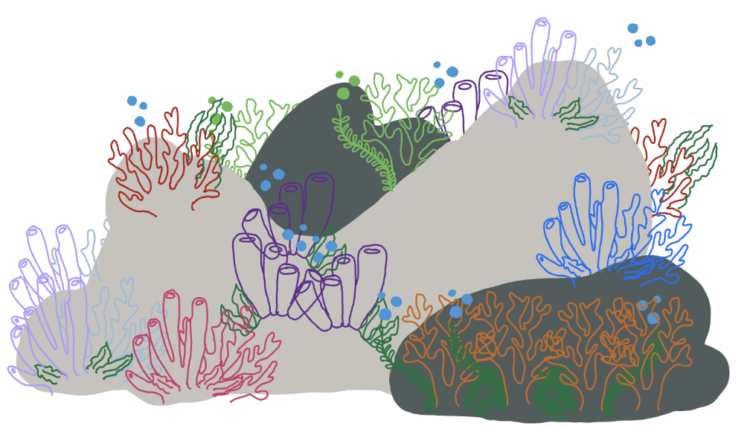

A bright rainbow lines the sand, rocks, depths of the ocean or just below the naked eye’s view from a boat. Put on your snorkel and enjoy the view; the beauty not only attracts us to see, but numerous animals who call this place home. What is that home made of, well… it’s coral! Now imagine that home, pale white, still and vibrance turned death, losing the tenants that once filled its crevices, a reef empty from what it once was.
What is coral? Some colorful rocks in a bed of rock and sand? A plant? Nope! The coral is an animal, but more like multiple animals in one. They are made from a bunch of smaller pieces called coral polyps which are connected, grow, and survive dependent on each other. But these polyps are clear. How would all these reefs have corals flooded with color then? Well, they have a mutually beneficial relationship- symbiotic relationship- with different algae that give them their color. Their color is a bonus, but a specific algae known as zooxanthellae helps them by eating the corals’ waste and using it for energy to make their own food via photosynthesis. The algae waste known as biproducts are oxygen and carbohydrates which the coral takes in to help it grow and expand into the beautiful, luscious reefs everyone thinks of. (National Geographic Society, 2026) These reefs are found all over the world; they can be found in the tropical shallow to deepest depths of the ocean. In the tropical side, we can find reefs from many countries, but the most notable reefs are found in Australia, Philippines, Fiji, the Maldives, Papa New Guinea and Indonesia! (Coral Reef Alliance, n.d.) Interestingly enough, there more species of deep-sea coral discovered in the freezing cold depths of the ocean in comparison to the shallow water coral seen in the tropic regions. These species have no dependence on sunlight for survival. (Smithsonian Ocean, n.d.)
Why corals’ health should matter goes beyond their species population count. They shape habitats, economy and life outside of the water. Healthy reefs are home to thousands of organisms, from fish to turtles and more! They provide habitat, which in turn provides food sources to all life there. Economies are built on the chance to see these underwater beauties via snorkeling, fishing, and diving. Another big portion comes from how coral reefs protect us. Coastlines are shaped from the power that comes from the water. Erosion is a prominent issue on those lines as people’s homes could be nearby. Coral reefs act as a barrier and stop waves from coming too hard, thus protecting us, especially from storms! (National Oceanic and Atmospheric Administration [NOAA], n.d.)
The real point is that these corals are key to so many different things, from tourism and coastline protection to homes for our underwater friends. That’s why the threat to coral reefs is an issue for all to know. Without them, we’d lose so much, so we must learn how we as communities and scientists can put ourselves to work to save them. (Hobson, 2026)
What Is Causing Coral Reefs to Die?
Corals need sunlight to help the algae inside them do photosynthesis, clean water to allow the light to pass through to those algae. Additionally, suitable water temperatures are a narrow range for reef building corals from 73 °F to 84 °F. This is decently high, but there are some that can survive as low as 60°F and as high as 90°F. (Coral Reef Alliance, n.d.) There is a phenomenon called coral bleaching which is affected when those conditions struggle to be met. This is particular to coral because they are bound to their location and cannot stray away when poor conditions arise. If temperatures rise, the algae within the coral can expel toxic chemicals, so in turn the coral expels it to save itself, however this will turn it white and eventually lead to weakness or death if the conditions continue. (Hobson, 2026)
Where is this heat coming from? Well, warmer waters and pollutions from humans are a root to so many of these underwater heat waves, harming and killing the coral to become a sea of white. Climate change is shaping the water below to risk the lives of each of these corals. They can recover with time, but those windows of time are closing as the conditions are getting worse. The rainbow within the salt water has diminished and we have to be able to recognize and stop it from happening. (Hoegh-Guldberg O. 1999)
All our reefs disappear; then what? Our fish, turtles, crabs and more, lose their home, their hunting ground and their hideouts. This is a rough path for young animals because their chance to grow is inhibited by the habitat that’s presented to them. Less chance for these young animals to hide from larger predators, eggs at risk of being eaten because of visibility to the naked eye, and the food sources are depleted as feeding areas become scarce.
The further consequences involve humans. Fishing that may have been prominent can be depleted leading to resource scarcity, tourism ruined by the death, decreasing the economy and the barrier from storms to the coastline are now battered without the reef as protection. This shows the integral role of coral reefs to more organisms within the ecosystem, from fish to people like us and even the structure of the ecosystem seen in the coastlines. Without corals, an underwater community is truly at risk.
Can We Save the Reefs?
There are so many things we can do to take care of the corals. There are safe practices for people who participate in underwater tourism like snorkeling and scuba diving. It is ideal to keep any body parts, tools, anchors and more away from touching the brittle parts of the reef. Also, keeping sunscreen and other products off your body is a good way to prevent different chemicals from infiltrating the induvial corals. Additionally, everyday practices to prevent more climate change, such as limiting pollution, public transport, saving energy and spreading the word on saving our reefs! (U.S. Environmental Protection Agency, n.d.) One step at a time, we can bring back the rainbow and preserve a home to many of our underwater friends!
Scientific Sources
National Geographic Society. (2026, September 15). Coral. National Geographic Education. https://education.nationalgeographic.org/resource/coral/
Coral Reef Alliance. (n.d.). Where are coral reefs located? https://coral.org/coral-reefs-101/geography/
Smithsonian Ocean. (n.d.). Deep-sea corals. https://ocean.si.edu/ecosystems/coral-reefs/deep-sea-corals
National Oceanic and Atmospheric Administration. (n.d.). Coral reef ecosystems. https://www.noaa.gov/education/resource-collections/marine-life/coral-reef-ecosystems
Melissa Hobson. (2026, September 9). See how much corals have declined in just 40 years. National Geographic. https://www.nationalgeographic.com/environment/article/global-status-coral-reef-data-climate-change
Coral Reef Alliance. (n.d.). What do corals reefs need to survive? https://coral.org/coral-reefs-101/what-do-corals-reefs-need-to-survive/
U.S. Environmental Protection Agency. (n.d.). What you can do to help protect coral reefs. https://www.epa.gov/coral-reefs/what-you-can-do-help-protect-coral-reefs
Hoegh-Guldberg O. (1999) Climate change, coral bleaching and the future of the world’s coral reefs. Marine & Freshwater Research 50, 839–866. https://doi.org/10.1071/MF99078