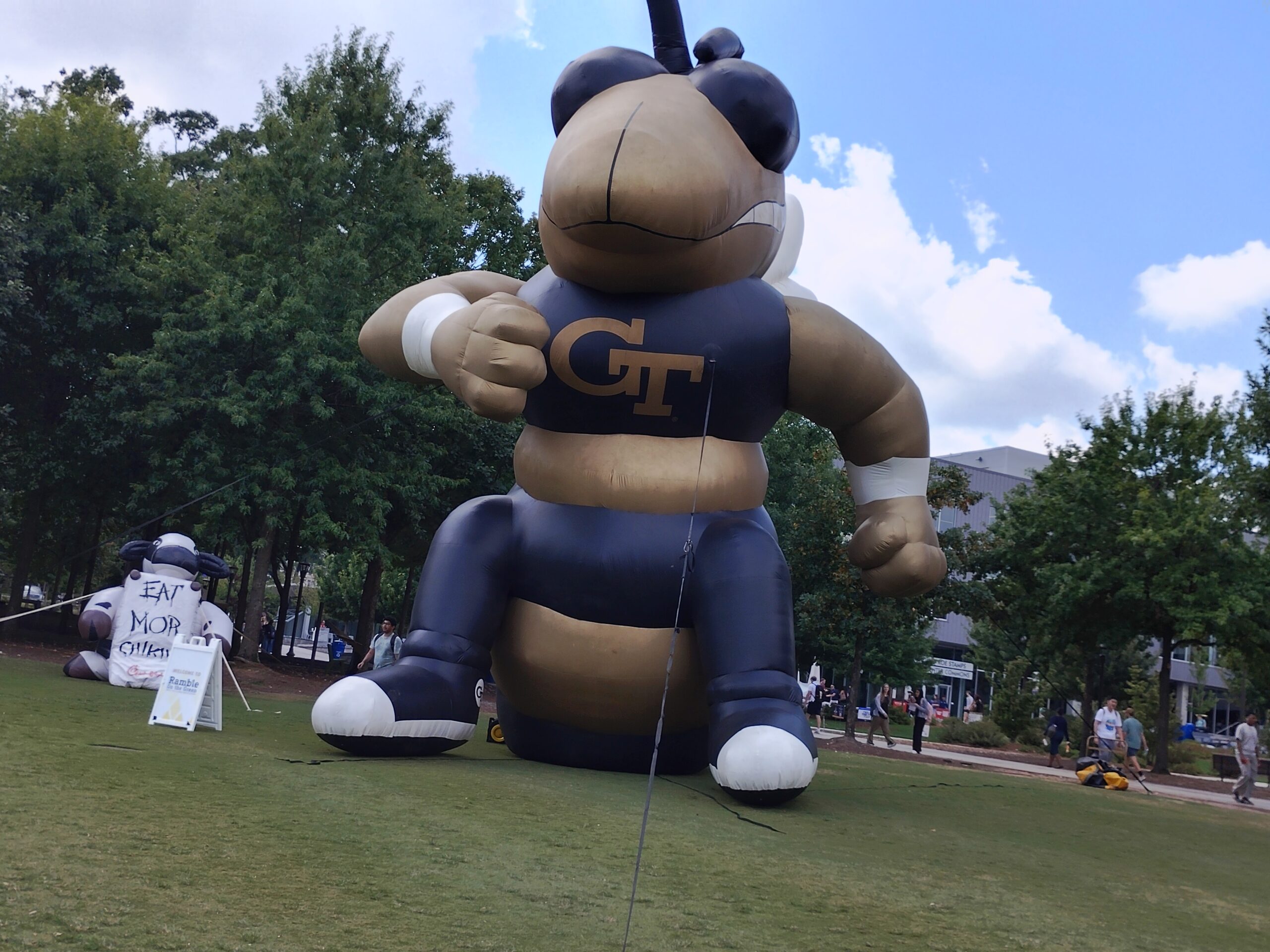

If you weren’t aware, Charged Magazine is run by a group of wonderful people at the Georgia Institute of Technology! In almost every other situation, that wouldn’t really matter, but the subject of this article is intrinsically tied to the university we come from: our mascot!
Buzz (with no canonical last name, to my knowledge) the yellowjacket has become the first thing I think of whenever I think of Georgia Tech. The school’s own word on him says it far better than I ever could: after all, Buzz is “more than just a mascot”, but an “icon” (Georgia Institute of Technology, 2023) of his own making.
Much like many other colleges, Buzz has his own social media presence. In the pursuit of forging his own identity, we’d certainly hope that most people would get his species right… but, from time to time, I’d end up seeing the titular yellowjacket be referred to as a wasp (which, while broader, isn’t incorrect), or a bee—which is entirely incorrect!
I’ll give those people the benefit of the doubt, though. From a first glance, it’s hard to tell whether the yellow and black flying insect you’ve spotted is a bee or a wasp. In general, the bodies of bees and wasps (taking from the honeybee and the paper wasp, respectively) have a similar “waist-like” appearance, though they differ in shapes and sizes (Zhao et al., 2015).
Firing off some differences you can spot, the honeybee has a hairy abdomen and flat legs, while the paper wasp has a sleek abdomen and round legs (Zhao et al., 2015). It’s important to note that these comparisons apply specifically to honeybees and paper wasps. While these are examples of differences found among broader groups, they aren’t guaranteed to be universal.
Of course, I won’t just leave you with the physical differences. What about the ecological differences? Bees are well-known to be useful to humans and the ecosystems we depend on. Naturally, they play a role in the environment by pollinating wildflowers and agricultural crops (Sumner et al., 2018).
On the other hand, many people don’t realize that wasps are just as valuable to the world around us! Wasps regulate arthropod populations (which include insects, arachnids, crustaceans, and myriapods). In particular, they regulate insect vectors of human diseases and crop pests (Sumner et al., 2018).
Now that we’ve discussed the differences, what’s next? After all, this all has felt rather nitpicky… but that doesn’t mean it isn’t important to get the distinction right! If we look back at Georgia Tech’s description of Buzz, we see that he is “athletic, fearless, and full of personality” and “known for his pranks and playful nature” (Georgia Institute of Technology, 2023).
That leads us to a more social discussion about the perceptions of bees and wasps. If I were to ask you to share the first word you think of when seeing a bee versus seeing a wasp, I’d be willing to bet that you’d tell me a tamer, nicer word for the bee and a stronger, meaner word for the wasp.
It turns out that my little prediction is rather indicative of the general population! Words used to describe bees are functional and positive, while words used to describe wasps are emotive and negative (Sumner et al., 2018).
Of the ten most commonly used words for bees, most tended to reflect their function and use to humans and their ecosystems, like “honey”, “flowers”, “pollen”, and “pollination”. When it comes to wasps, opposite patterns sprang up, with words like “sting”, “annoying”, “dangerous”, and “angry” (Sumner et al., 2018).
On first inspection, this doesn’t seem to justify the decision to make Buzz a yellowjacket… after all, why would Georgia Tech bother with such a divisive creature? Well, I think it paints a clear picture of the perception that the school wants Buzz to give off. We don’t settle for a “helpful, passive” bee, but a “confident, active wasp”! Of course, this contrast isn’t reflective of the actual insects; rather, it’s the product of how we as a society tend to perceive them.
As we slowly march our way back to the beginning, I’d like to poke at the reader’s mind for a bit. While you’ve been reading this article, I’m willing to bet that you’re at least a little curious as to why it even exists! I don’t take offense to it, don’t worry (mainly because I’m about to give a reason)…
If you’re a Georgia Tech student, listen up. Buzz is a yellowjacket. Not a bee. By mixing up the species, you inadvertently ruin the point of the character! (OK, maybe I’m being a little facetious, but still…) Lord knows we need all the school spirit we can get, considering our football team’s track record…
If you’re not a Georgia Tech student? Listen up! (Maybe even more…) Buzz is a yellowjacket. Even when you beat us next season, know that we went down fighting!
Reference List
Georgia Institute of Technology. (2023). Buzz. Georgia Tech Yellow Jackets. https://ramblinwreck.com/buzz
Sumner, S., Law, G., & Cini, A. (2018). Why we love bees and hate wasps. Ecological Entomology, 43(6), 836–845. https://doi.org/10.1111/een.12676
Zhao, Z.-L., Zhao, H.-P., Ma, G.-J., Wu, C.-W., Yang, K., & Feng, X.-Q. (2015). Structures, properties, and functions of the stings of honey bees and paper wasps: A comparative study. Biology Open, 4(7), 921–928. https://doi.org/10.1242/bio.012195
