
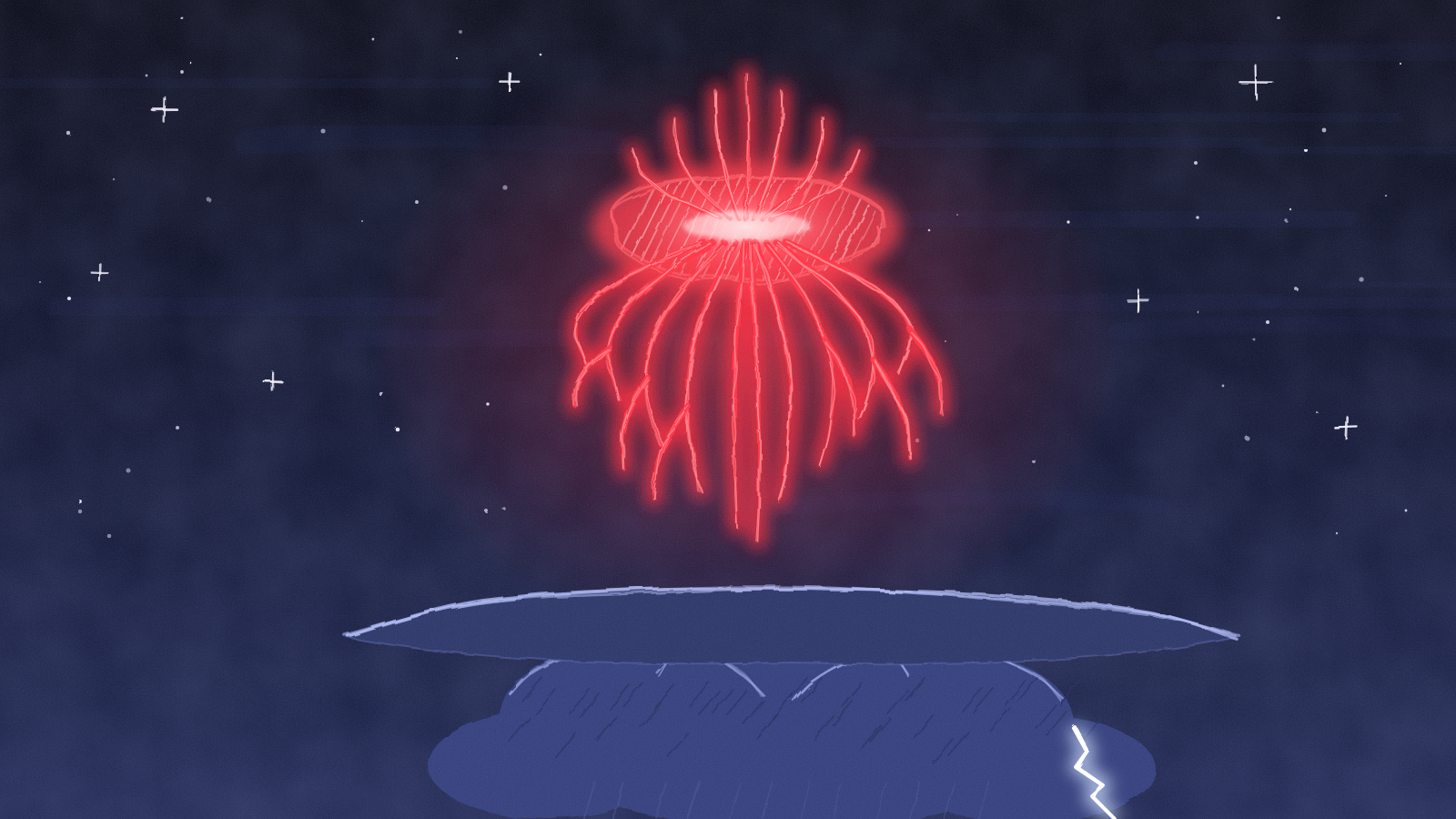

Discover the science behind red sprites.
This looks like science fiction. But something this strange actually happens above thunderstorms on Earth.
Wait, what is that?
That red, jellyfish-looking thing is a red sprite: a quick electrical discharge that happens way above thunderstorms, about 50–85 km up according to NASA. For comparison, planes cruise at around 5–7 miles (8–11 km). Sprites are a type of transient luminous event (TLE), which basically means a short flash of light in the upper atmosphere, and they’re the most commonly spotted kind.
Also, a sprite isn’t lightning shooting up out of the cloud. It lights up on its own, way higher up, with dark sky in between.
How does it happen?
Inside a storm, positive charge usually builds up near the top of the cloud and negative charge lower down. Most lightning sends negative charge to the ground, but every so often a really strong positive strike hits instead. That suddenly changes the electric field above the storm, which speeds up electrons in the thin air up there. They crash into molecules and make the air glow.
This doesn’t happen after every strike. NASA says only about 10% of lightning is positive, and only about 2% of those are strong enough to set off a sprite.
Okay, but why red?
Nitrogen, which makes up most of the air we breathe. When those fast electrons slam into nitrogen molecules, the molecules take in some energy and give it back off as light. Up there, that light is mostly red.
Fun fact: nobody even photographed a sprite until 1989, and that was by accident.
Quick quiz
1. Where do sprites happen?
A) Inside the storm cloud
B) High above the storm clouds
C) Right above the ground
Check your answer
B! Sprites show up way above the storm, roughly 50–85 km up, with dark sky between them and the cloud.
2. What speeds up the electrons that make a sprite glow?
A) Heat from the storm
B) Sunlight
C) An electric field
Check your answer
C! A strong positive lightning strike changes the electric field above the storm, and that field is what speeds the electrons up.
Check your answer
B! Electrons hit nitrogen molecules, and the molecules release that extra energy as mostly red light.
3. What speeds up the electrons that make a sprite glow?
A) Heat from the storm
B) Sunlight
C) An electric field
Check your answer
B! Electrons hit nitrogen molecules, and the molecules release that extra energy as mostly red light.
The sky doesn’t need a portal to look otherworldly.
References:
Tran, L. (2022, October 27). The great sprites chase. The Sun Spot. https://science.nasa.gov/blogs/the-sun-spot/2022/10/27/the-great-sprites-chase/
Schmidt, S. (2024, October 6). Sprites, camera, action! NASA Earth Observatory. https://science.nasa.gov/earth/earth-observatory/sprites-camera-action-153422/
