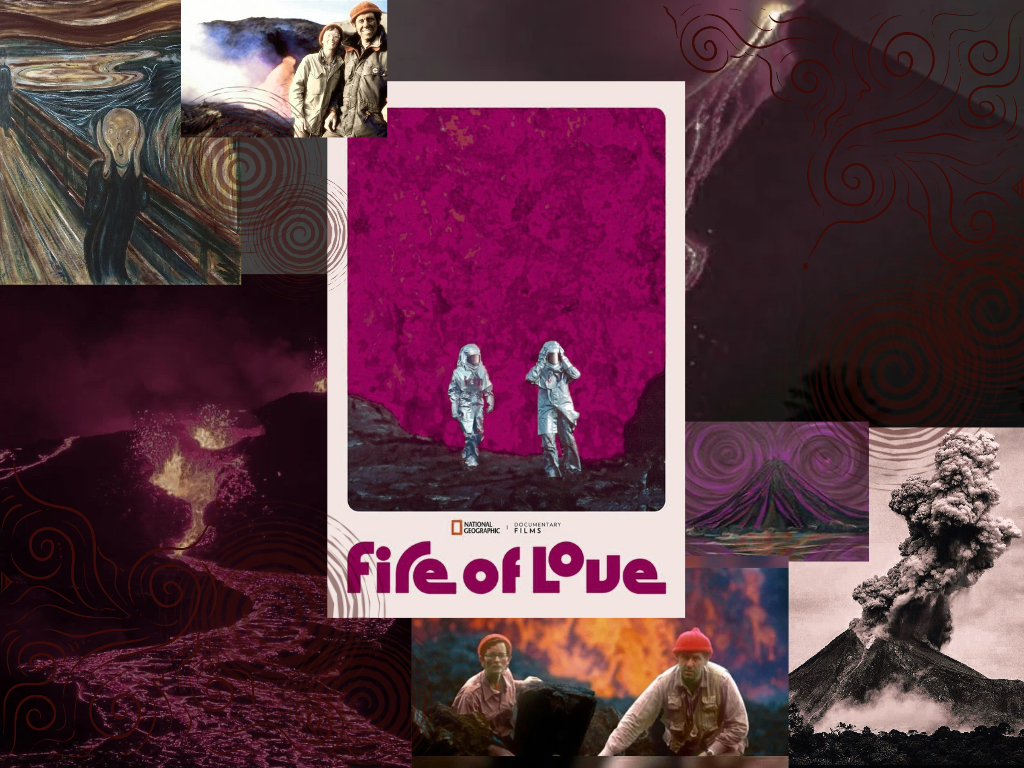

Fire of Love is a documentary about two volcanologists, Katia and Maurice Krafft, who loved volcanoes with everything they had. And how their everything was the thing that ultimately led them to lose their lives. Katia and Maurice’s love for volcanoes started young. Maurice fell in love with Mount Stromboli on his first visit, and Katia fell for Mount Etna, both volcanoes in Italy. Their love for volcanoes drew them to each other, and together they lived for their love. Katia and Maurice were volcanologists, and as volcanologists, you can imagine they studied volcanoes. The documentary described their study of volcanoes as an observational science. The closer you get to a volcano, the more details and phenomena you can capture. Katia and Maurice loved to get close to volcanoes.
Volcanoes and Boxes
When asked, Katia and Maurice said they didn’t like to categorize volcanoes because of how unique each one was. But if they had to squish volcanoes in a box, they’d place them in two. Either red volcanoes or grey volcanoes. A red volcano forms as tectonic plates pull apart and at hot spots on the ocean floor. It’s what people imagine when they think of volcanoes: flowing rivers of hot red lava. Grey volcanoes are explosive, unpredictable, and dangerous and produce massive, grey clouds. These are described as the killers compared to the relatively predictable red volcanoes.
The Shifts: Pivot in their Career
The volcano that brought about a shift in Katia and Maurice’s study of volcanoes was Mount Helen. It was a grey volcano and erupted on May 18th, 1980, with a magnitude 5.1 earthquake. It triggered a landslide, leveling 230 square miles of forest and costing 57 people their lives. The volcanologists put their love of volcanoes towards studying a way to predict the moment volcanoes decide to erupt to prevent the danger they can cause to people. They knew that volcanoes could be a destructive force, but they also knew how that destruction could bring about new creation.
November 13, 1985, Nevado del Ruiz erupted in Colombia and caused volcano mudflow to run down into neighboring villages killing around 20,000 people and injuring 5,000. It was a catastrophic and disastrous event that could have been prevented. Scientists had warned the government to make evacuation plans in preparation for the eruption, and despite the government starting the process, they moved at a snail’s pace. The documentary states that the government didn’t want to pay the money for the plans. The effects of that decision were devastating. Both Katia and Maurice witnessed that and, from that point on, to study and spread awareness about volcanic hazards and mitigation.
A study found that 5 ways to mitigate volcanic risk are “(1) identification of high-risk volcanoes; (2) hazard identification, assessment, and zonation;(3) volcano monitoring and eruption forecasting; (4) engineering-oriented measures; and (5) volcanic emergency Management.” It’s important for governments that have high-risk volcanoes or are at risk for any other natural disaster to invest in the prevention of those potential catastrophes. Investing in precautions can save many people’s lives, and that investment starts with the government.
And according to the documentary, which was released in 2022, the government has taken that step in prevention and care for its citizens.
Katia, Maurice, and Volcanoes
Claudia Principe, a retired Research Director and current Research Associate at the Pisa Institute of Geosciences and Earth Resources of the Italian National Research Council (IGG-CNR), summed up their career very succinctly; Katia and Maurice “visited over 300 volcanoes, witnessed around 175 eruptions, and produced over 20 illustrated books, thousands of photos, and numerous educational films.” The couple loved volcanoes deeply. They thought they were beautiful and enchanting and yearned to understand them without wanting them to understand them back.
Fire of Love does a beautiful job at showing the nuances of Krafft’s love for what they study and the danger in pursuing it. It presents a story of caution, passion, and love in such a delicate way that it hits you where it hurts. I was compelled from start to finish despite knowing how Katia and Maurice’s story ended. The story wasn’t about their death, but what they accomplished with their love during their life. If you’re at all intrigued by any of the parts of the story I presented to you, you should definitely head over to DisneyPlus and watch the documentary yourself! Trust me, you won’t regret it.
Works Cited
Decker, R., & Decker, B. (1981). The Eruptions of Mount St. Helens. Scientific American, 244(3), 68–81. http://www.jstor.org/stable/24964328
Voight, B. (1990). The 1985 Nevado del Ruiz volcano catastrophe: anatomy and retrospection. Journal of Volcanology and Geothermal Research, 44(3-4), 349-346. https://doi.org/10.1016/0377-0273(90)90027-D
Principe, C. (2026). Studying volcanoes from Italy to the world: my encounters with Katia Krafft. Geological Society, London, Special Publications, 564, https://doi.org/10.1144/gslspecpub2026-116
Tilling, Robert, I. (1989) Volcanic Hazards and their Mitigation: Progress and Problems. Reviews of Geophysics, 27(2), 237-269. https://doi.org/10.1029/RG027i002p00237