


Imagine this: you’ve just told the funniest joke of your life, and now you’re waiting for thunderous applause. Instead, as the room erupts, you hear a horrifying noise – something between a kookaburra cackle, hyena giggle, and a donkey hee-haw. You whip your head around and realize this horrid sound actually came from a human being! Everyone begins to laugh harder, turning away from you and towards the laughing perpetrator. The whole assembly sounds like a symphony! Except every instrument is different. And out of tune. And you’re in the audience. As a result, you become sure that this evil, conniving person has eclipsed your joke with their cackles.
Laughter is ubiquitous, and yet, every single one of us manages to have a distinct laugh (some laughs are certainly more distinct than others). You may wonder, how did each of us develop a unique laugh? Does the sound of our laughter come from our DNA, or do we unconsciously learn to laugh like the people around us? We will find that laughter actually has many ties to the former (our genetics).
To get to the bottom of this, let’s narrow our focus to the acoustic properties of laughter – its pitch, tone, and rhythm. To put it another way, we are looking strictly at the sound of a laugh. Furthermore, we’re focusing specifically on spontaneous laughter – uncontrollable and unexpected laughter.
Laughter and Human Evolution
At first, you might see child development and the cultural norms we have today and think that laughter is a learned quality. After all, don’t babies learn how to laugh from mimicking their parents during play? Don’t we change the sound of our laughter based on context? However, laughter actually has ties to human evolution!
First, let’s look at human laughter by comparing it to the laughter of our closest living relatives. Many great apes today such as chimpanzees and bonobos exhibit “pant-laughs” during playful interactions. Many scientists have noted that this play-panting is similar to human laughter because both cases of vocalization are triggered by social play and/or tickling (Gervais & Wilson, 2005). This similarity between species suggests that human laughter has some evolutionary origins, and some believe these origins go back a whopping 6.5 million years ago to a common primate ancestor of humans and great apes (Fry, 1994). In fact, some anthropologists theorize that the ritualization of spontaneous laughter developed long before human language took hold (which was about 2 million years ago) (Gervais & Wilson, 2005). In other words, laughter is very, very old.
Turning to another observation of our fellow hominids today, scientists also detail how laughter among primates can act as an automatic social coordination tool that bonds groups and communicates safety. This is likely why laughter developed among early hominids – to garner social interaction and protect one another (Gervais & Wilson, 2005). So all and all, in looking at our evolutionary history we find that laughter didn’t start as a cultural trend we simply copied. Instead, it evolved as a survival mechanism. Early humans who were genetically predisposed to laughing had a distinct evolutionary advantage, and, as a result, this reflex was built into our DNA over time.
Laughter and Human Anatomy
Evolutionary history isn’t the only clue pointing to our genes. We can also see the genetic blueprint of laughter by examining two parts of human anatomy: our brain and our respiratory system. Together, these biological systems, dictated by DNA, control both the involuntary trigger and the distinct acoustic sound of spontaneous laughter.
First, let’s look at our brains. In one fMRI study, researchers scanned participants’ brains while tickling them to induce spontaneous laughter. The scans revealed that the tickling lit up a neural network stretching from the nucleus accumbens (the brain’s dopamine-driven “reward center”) down to emotional and survival centers like the hypothalamus (which regulates basic bodily functions) and periaqueductal gray (a brainstem center for autonomic reflexes) (Westermann et al., 2022).
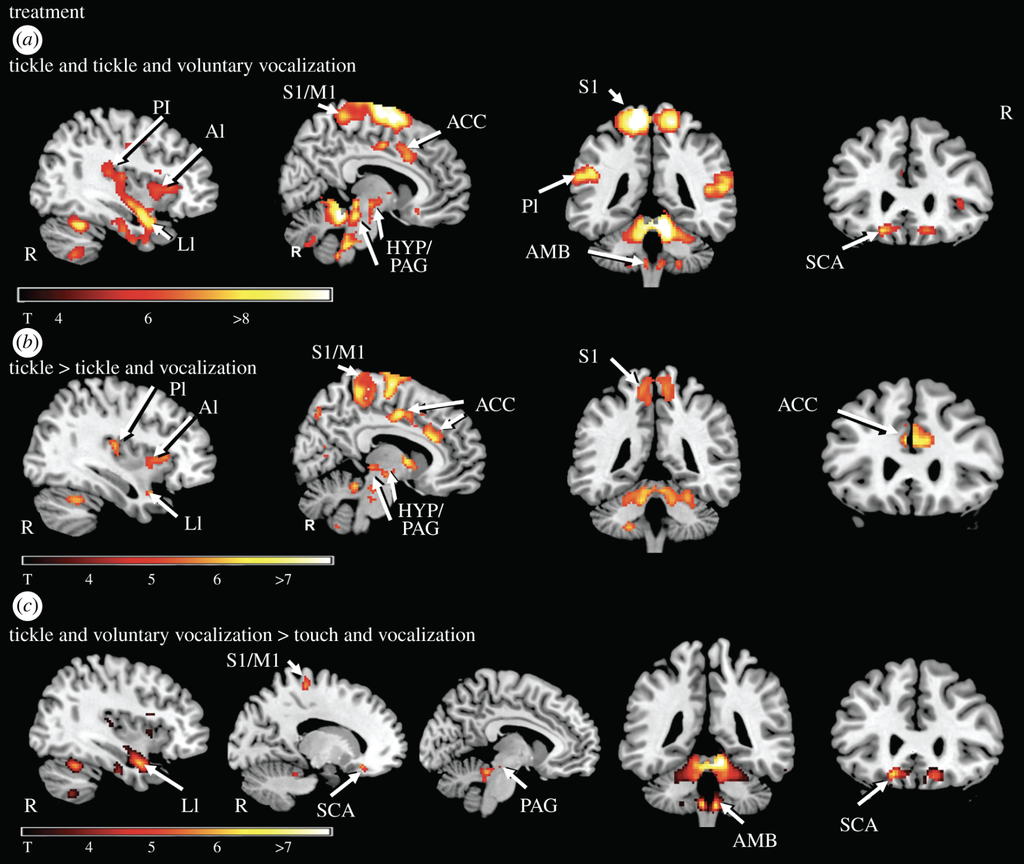
This image is directly taken from the study by Westermann et al. (2022). It shows different areas of the brain being triggered during different cases of tickling. In particular, notice the hypothalamus (HYP) and the periaqueductal gray (PAG) being frequently triggered.
Now, if you’re like me – definitely not a neuroscientist – the key takeaway is this: these affected regions operate independently of our own brain’s conscious, voluntary control centers (the parts we ourselves have authority over). Rather than routing through the prefrontal cortex or conscious speech regions where we plan what to say, spontaneous laughter is driven by deep subcortical and brainstem machinery that triggers our motor cortex directly, essentially forcing us to laugh. Additionally, neurological cases like gelastic seizures – rare epileptic episodes that cause sudden, emotionless fits of giggling – confirm that these deep brain circuits can trigger a laugh independent of conscious thought. Because these subcortical circuits run on pre-programmed genetic blueprints rather than socially learned speech patterns, we can conclude that the impulse and rhythm of a spontaneous laugh are built straight into our DNA (Westermann et al., 2022).
Additionally, our respiratory and vocal anatomy plays a major role in shaping the unique sound of a person’s laugh. To unpack the acoustic features behind laughter, one study examined 1,024 naturally-produced laugh bouts recorded from 97 young adult participants (male and female) watching humorous film clips. By measuring the fundamental frequency (f₀) of each laugh, researchers discovered remarkable pitch variability with some laughs having acoustic maximums of 1,000 to 2,000 Hz (Bachorowski et al., 2001).
In total, they found that a wide variety of factors determine the complex sound of a laugh, one factor of which is, unsurprisingly, a person’s vocal cords. The study distinguished between voiced laughter (which features rhythmic, musical vocal fold vibrations) and unvoiced laughter (which sounds more like a breathy huff due to a lack of vocal fold movement). Additionally, the researchers examined how the vocal tract above the larynx acts as an acoustic filter, shaping the sound via F₁ and F₂ formant frequencies. Ultimately, this research demonstrates that pitch and laugh cadence are physically dictated by respiratory anatomy, the structure of which, like the brain’s motor cortex, is determined by DNA (Bachorowski et al., 2001).
Evidence for Hereditary Laughter: Deaf Individuals
Finally, some of the most compelling evidence for the heritability of spontaneous laughter comes from studies of deaf individuals. If we believed that the sound of a laugh was determined primarily by an person’s lived-experience (which is the case for human language), we might expect deaf individuals – especially those who were born deaf – to laugh noticeably differently than their hearing peers. After all, they would have never heard another person’s laugh to imitate.
Yet research finds the exact opposite! In a landmark study comparing 19 deaf college students with 23 hearing participants, researchers found that the laughter produced by deaf participants was fundamentally similar in sound to that produced by hearing individuals. Both groups showed the same mean fundamental frequency (f₀) and the same range of acoustic variety – spanning voiced and unvoiced bouts, open- and closed-mouth laughs, and similar laugh durations. All of these similarities support the idea that laughter is an innate biological behavior. Even without auditory feedback, the human vocal system naturally produces typical laughter – strong evidence that our signature laugh is pre-programmed into our genetics rather than copied from the crowd (Makagon et al., 2008).
Conclusion
At its core, spontaneous laughter is a direct expression of our evolutionary biology. Over millions of years, humans developed a vocal reflex deeply ingrained in our genetics. When triggered, neural pathways bypass our main control centers and speech regions to produce involuntary contractions in our vocal folds. This is demonstrated in the case of deaf students who laugh in a similar way to hearing peers.
It’s important to note that, if we had studied volitional laughter (deliberate laughter) more deeply, social context would have become more important. In other words, laughter would vary based on the situation. For example, the laugh you roar when a friend makes an outrageous comment would be wildly different from the polite chuckle you fake when your professor makes a terrible joke.
So the next time someone nearby lets out a bizarre spontaneous cackle, remember: that laugh likely wasn’t learned, but rather that laugh was a unfortunate result of their own DNA and humanity’s evolutionary history.
References
Bachorowski, J.-A., Smoski, M. J., & Owren, M. J. (2001). The acoustic features of human laughter. The Journal of the Acoustical Society of America, 110(3), 1581–1597. https://doi.org/10.1121/1.1391244
Fry, W. F. (1994). The biology of humor. Humor: International Journal of Humor Research, 7(2), 111–126. https://doi.org/10.1515/humr.1994.7.2.111
Gervais, M., & Wilson, D. S. (2005). The evolution and functions of laughter and humor: A synthetic approach. The Quarterly Review of Biology, 80(4), 395–430. https://doi.org/10.1086/498281
Makagon, M. M., Funayama, E. S., & Owren, M. J. (2008). An acoustic analysis of laughter produced by congenitally deaf and normally hearing college students. The Journal of the Acoustical Society of America, 124(1), 472–483. https://doi.org/10.1121/1.2932088
Westermann, B., Lotze, M., Varra, L., Versteeg, N., Domin, M., Nicolet, L., Obrist, M., Klepzig, K., Marbot, L., Lämmler, L., Fiedler, K., & Wattendorf, E. (2022). When laughter arrests speech: fMRI-based evidence. Philosophical Transactions of the Royal Society B, 377(1863), Article 20210182. https://doi.org/10.1098/rstb.2021.0182
