
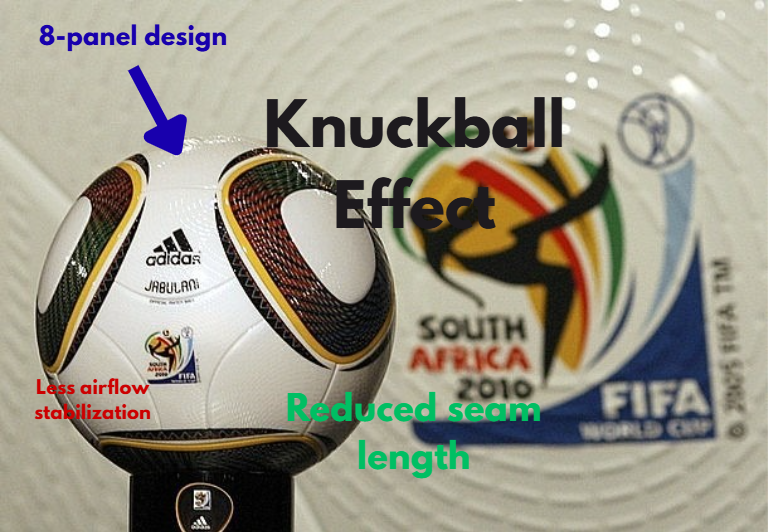

In a World Cup that captured the eyes of billions and brought fans from across the world together, the soccer ball became the story. The Jabulani, infamous for its knuckling and unpredictable effects, caused widespread uproar among players while engraving other players’ names in the history of football.
Soccer’s accessibility has made the sport a global phenomenon with people across language and physical barriers playing the beautiful game. To play soccer, all you need is a ball and four rocks to make the goals, so with the globalization of the sport, innovation in how the game is played has occurred. Teams have engineered fields with halo screens and retractable panel screens, technology that can determine the position of soccer players with a 2-cm error margin, and goals that can withstand any weather the environment has to offer. So naturally, we have seen evolution in soccer balls, beginning from rubber to now aerodynamic spheres engineered to maximize control and durability. However, amongst this growth, the Jabulani stands as the most hated ball. Goalkeepers in particular detested the ball, with legends like Joe Hart, Tim Howard, and Iker Casillas all critiquing the unpredictability and almost supernatural feel of the ball (Uncut Football Editorial, 2026). While Diego Forlán embraced the change, asking for a ball three months early from Adidas, where he then practiced extensively, leading to him scoring several stunning long-distance goals and winning the Golden Ball, the award for the World Cup’s best player.
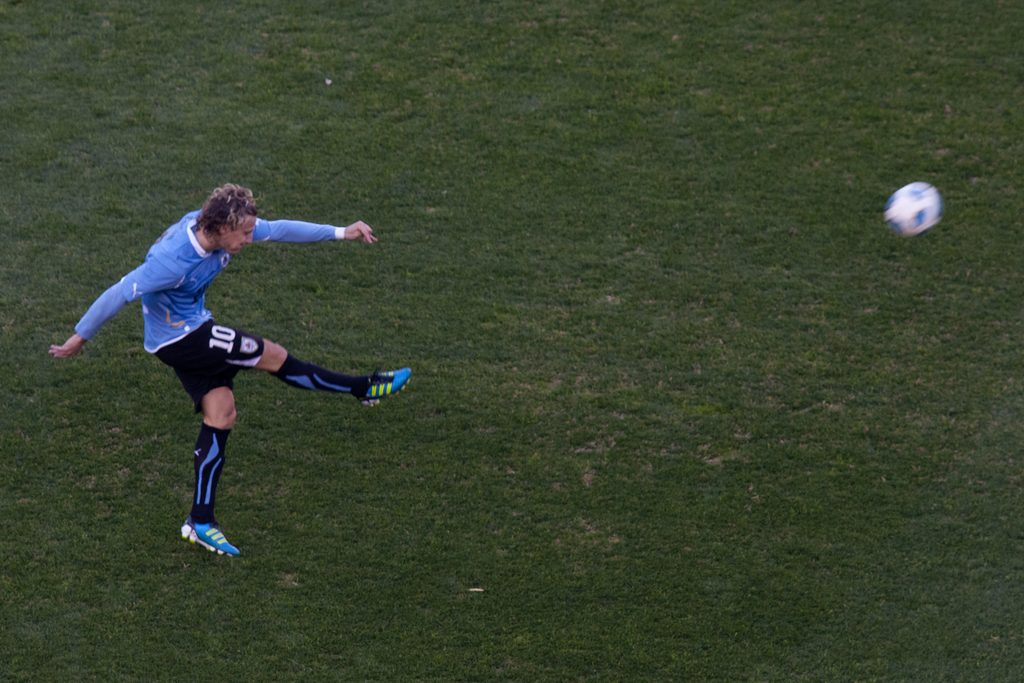
(Baikovicius, 2011)
Physically, the ball was entirely different from any ball ever made. The manufacturers abandoned the traditional 32-panel design, instead shifting to a never-before-seen eight-panel design, in an attempt to improve the aerodynamics (Asai & Seo, 2013). In addition to the decrease in panels, the ball also had a smaller total seam distance at 1980 mm, where shorter seam length is associated with the ball’s ability to stabilize airflow (r=0.9 between seam length and aerodynamic behavior) (Asai & Seo, 2013). The ball also had a higher Critical Reynolds Number (a measure that predicts how air flows around an object) than the balls from previous Euros and Olympics. The Reynolds number was 3.3 x 10⁵, meaning that at match speeds the ball could experience knuckling and unpredictable behavior, traits that made this ball infamous (Asai & Seo, 2013). These changes in the ball led to different drag characteristics, which further support the claims made by many players. Additionally, using a kicking robot and force plate, researchers measured that the Jabulani produced the largest impulse at all kicking speeds compared to other Adidas soccer balls: 10.97 Ns at 20 m/s and 12.11 Ns at 25 m/s (Koizumi et al., 2014). Impulse is the change in momentum, and momentum is velocity times mass, so if the ball receives a greater impulse, the ball will generally have a larger velocity. Since the ball had a larger impulse or momentum transferred from the foot to the ball, the Jabulani could experience higher speeds once kicked, explaining the belief of the 5-time IFFHS best goalkeeper, Iker Casillas, that the ball traveled faster. Overall, the evidence suggests that the Jabulani’s unique construction and aerodynamic properties contributed to the unpredictability concerns about the ball during the 2010 World Cup.
References
adifansnet. (2009, December 8). JABULANI [Photograph]. Flickr. https://flic.kr/p/7modQn
Asai, T., & Seo, K. (2013). Aerodynamic drag of modern soccer balls. SpringerPlus, 2(1), 171. https://doi.org/10.1186/2193-1801-2-171
Baikovicius, J. (2011, July 25). Diego Forlán | 110724-9242-jikatu [Photograph]. Flickr. https://www.flickr.com/photos/jikatu/5973455170/
Koizumi, A., Hong, S., Sakamoto, K., Sasaki, R., & Asai, T. (2014). A study of impact force on modern soccer balls. Procedia Engineering, 72, 423-428. https://doi.org/10.1016/j.proeng.2014.06.074
Uncut Football Editorial. (2026, July 11). How football spent 16 years trying to solve the Jabulani problem, only to end up back where it started. Uncut Football. https://uncutfootball.com/stories/how-football-spent-16-years-trying-to-solve-the-jabulani-problem [uncutfootball.com]
