
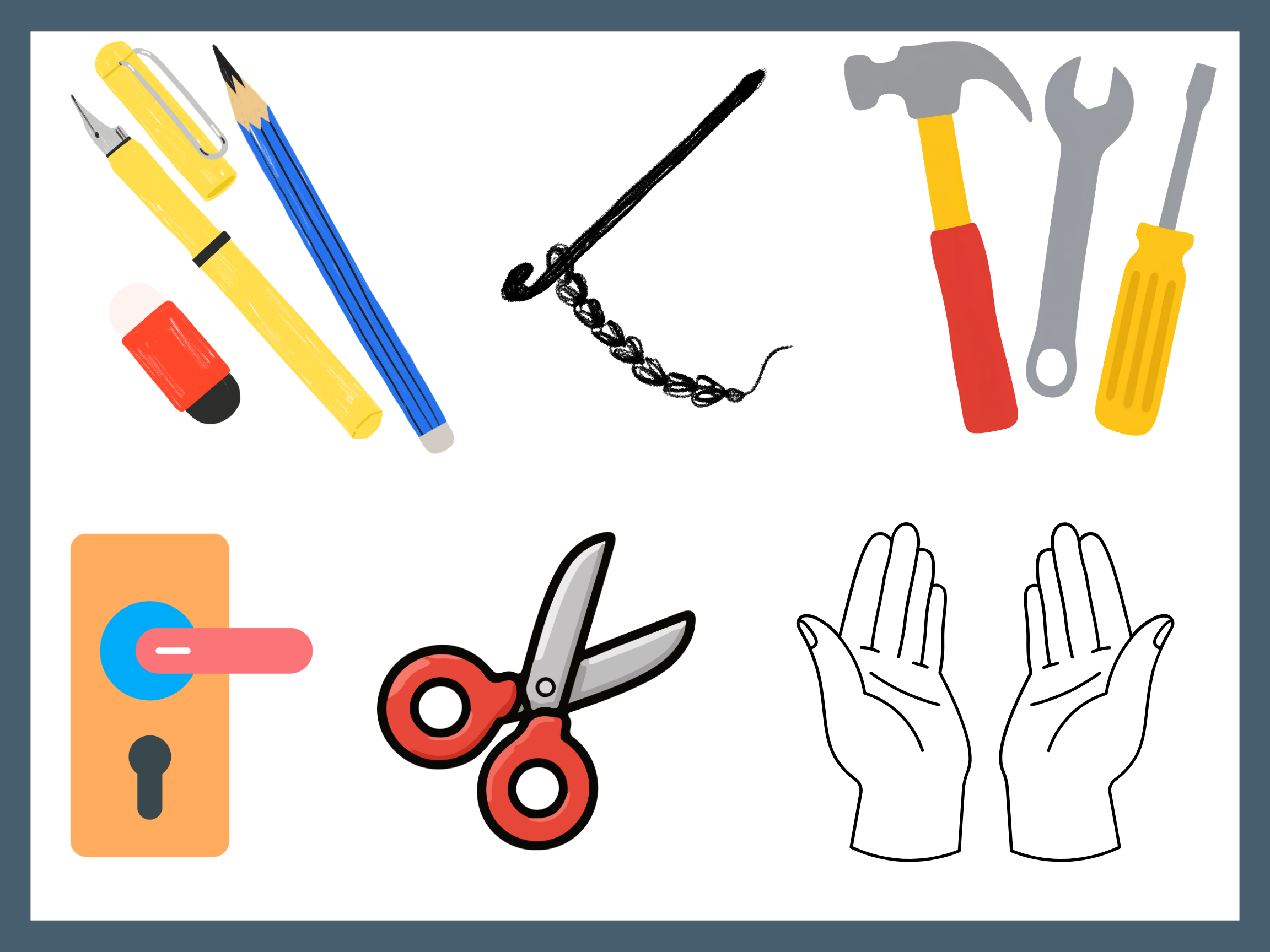

Have you ever wondered why computer mice are always to the right of the keyboard, or thought about the positioning of marks on a measurement cup? A wide variety of items are designed on the assumption that participants will use their right hand, from tools to zippers to doorknobs (Jones 2025). So why is handedness such a big deal? What makes someone right- or left-handed? And are there really large differences between a lefty and a righty?

What is handedness?
Surprisingly, there is no standard definition of “right-handed” or “left-handed” (Dexheimer and Sainburg 2025). The terms refer to which of a person’s hands is dominant, but dominance can be defined by any of the following:
- A preference for one hand when performing a skilled manual task
- Performance differences between the two hands
- A self-report from the person being asked (that is, “dominance” is whatever that person decides)
Another factor in determining someone’s handedness is whether mixed-handedness is considered. Just as left- and right-handedness are hard to describe, mixed-handedness is vaguely considered to be a tendency to use different hands for different tasks (Ocklenburg 2023, Ocklenburg 2026). A mixed-handed person might use their right hand to write, but prefer their left hand when brushing their teeth, for instance.
A final category in the handedness confusion is ambidexterity. An ambidextrous person can use both hands equally well for skilled motor tasks (Ocklenburg 2023). Ambidexterity and mixed-handedness are often confused, and researchers are trying to solve the issue by clarifying how they are defined. Because mixed-handedness is based on the idea of hand preference, while ambidexterity depends on performance, ambidexterity is usually confirmed by measuring a person’s skill level on a particular task (ex. writing) with both hands. In contrast, mixed-handedness would be determined by giving them a survey about which hand they use for a variety of tasks.
What makes a person left-handed or right-handed?
Handedness is caused by a variety of influences. Genetics play a significant role, but there isn’t a single gene that causes right- or left-handedness. Instead, multiple genes (possibly as many as 40) seem to increase the likelihood of dominance in one hand or another. In addition, specific genes such as PCSK6 and LRRTM1 have been found to be associated with being left-handed or mixed-handed (Dexheimer and Sainburg). A person is more likely to be left-handed if one or both of their parents is left-handed, but this doesn’t guarantee left-handedness (Medline 2022). Basically, genes set the stage for the development of handedness, but they don’t control it.
Certain environmental factors may also influence a person’s handedness. Adults may model use of one hand over another when it comes to writing or eating, encouraging young children to favor the same hand for those behaviors. (Parents are sometimes advised not to do this in order to allow their children to develop without interference.) It has also been proposed that in utero positions or the way a child is carried by an adult could shift hand preference (Dexheimer and Sainburg 2025).
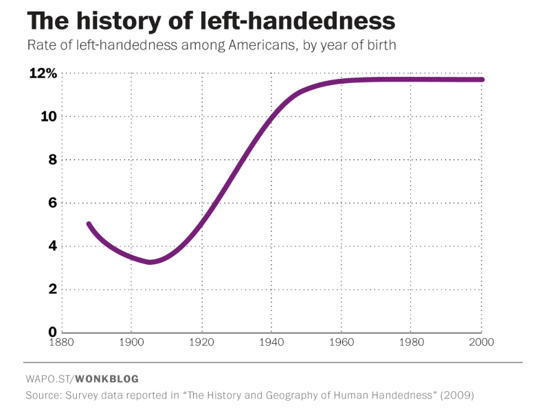
A final influence is societal acceptance of left-handedness. Historically, left-handedness was seen as strange and suspicious, and many children were forced to switch to the “correct” hand for writing and other tasks. Left-handed individuals experienced significant pressure to appear right-handed, reducing the apparent rate of left-handedness during the late 1800s and early 1900s (Southpaw 2026). In the modern-day United States, however, there is much less stigma, which has unsurprisingly coincided with a “rise” in the left-handed population.
An Evolutionary Advantage?
Handedness differences might seem random and meaningless, but there is likely a deeper reason for the existence of left- and mixed-handedness. The ratio of right- to left-handed people in the human population is roughly 90% to 10% (depending on the definition of handedness, of course), and it appears to have remained constant throughout history (Dexheimer and Sainburg 2025, Southpaw 2026). This begs the question: Why would humans need handedness variation?
The answer may lie in evolutionary game theory, a way of thinking about the strategic elements of evolution that derive from competition for survival and offspring. Evolutionary game theory was originally proposed when biologists noticed that the number of grandchildren each individual produced could be used as a measure of evolutionary fitness. Analyzing population characteristics with this criterion in mind explained certain questions about those populations, such as why many species have roughly equal proportions of male and female individuals (Stanford Encyclopedia of Philosophy 2021).
Applied to handedness, evolutionary game theory suggests that having a small but significant percentage of people who are not right-handed offers evolutionary advantages, as variation allows a population to thrive (Dexheimer and Sainburg 2025). Left-handed and mixed-handed people might be able to exploit situations that the right-handed cannot, promoting their survival and increasing the number of descendants they leave behind. If this is true, it explains why handedness differences are useful and why they have been preserved throughout our evolutionary history despite societal pressures against it and bias in the construction of everyday items to favor the right-handed.
Fun Facts
- Sex differences in handedness have been noted in a variety of studies. Generally, they find that boys are more likely to be left-handed than girls. However, the magnitude of the difference varies by study and depends on how the researchers defined handedness (Papadou-Pastou et al. 2008). When handedness is defined using criteria that exclude mixed-handedness and ambidexterity, the gender ratio is more equal. Therefore, boys may actually have a higher rate of ambidexterity than girls.
- Handedness may have a relationship with language lateralization in the brain (Dexheimer and Sainburg 2025). In most people, the majority of functions related to language rules and production are handled by specialized centers in the brain’s left hemisphere. However, left-handed people are more likely to have right-hemisphere language lateralization or bilateral language processing. This relationship is tentative and probably not causal, but it demonstrates an interesting facet of how the brain specializes as it develops.
- Have you heard of any historical figures who were left-handed, mixed-handed, or ambidextrous? Probably. Leonardo da Vinci was left-handed and wrote in mirror script, possibly to lessen ink smudges, and Julius Ceasar could reportedly fight with either hand (Southpaw 2026). Handedness differences have existed throughout history, regardless of time period, country, or culture.
Sources:
Alexander, J. M. (2002, January 14). Evolutionary game theory. Stanford Encyclopedia of Philosophy. https://plato.stanford.edu/entries/game-evolutionary/
Dexheimer, B., & Sainburg, R. L. (2025). Handedness. Encyclopedia of Exercise Medicine in Health and Disease, 1–4. https://doi.org/10.1007/978-3-642-27830-3_296-1
Jones, E. (2025, December 1). 20 everyday designs that favor right-handed people. City State Zip Code. https://citystatezipcode.com/20-everyday-designs-that-favor-right-handed-people/
Ocklenburg, S. (2026). Am I left-handed or mixed-handed?. Psychology Today. https://www.psychologytoday.com/us/blog/the-asymmetric-brain/202601/am-i-left-handed-or-mixed-handed
Ocklenburg, S. (2023). The difference between mixed-handedness and ambidexterity. Psychology Today. https://www.psychologytoday.com/us/blog/the-asymmetric-brain/202312/the-difference-between-mixed-handedness-and-ambidexterity
Papadatou-Pastou, M., Martin, M., Munafò, M. R., & Jones, G. V. (2008). Sex differences in left-handedness: A meta-analysis of 144 studies. Psychological Bulletin, 134(5), 677–699. https://doi.org/10.1037/a0012814
Southpaw, S. (2026, September 18). History of left-handedness: A timeline from ancient Rome to today. lefthanded.io. https://lefthanded.io/history-of-left-handedness/
U.S. National Library of Medicine. (2022). Is handedness determined by genetics?: Medlineplus Genetics. MedlinePlus. https://medlineplus.gov/genetics/understanding/traits/handedness/
