
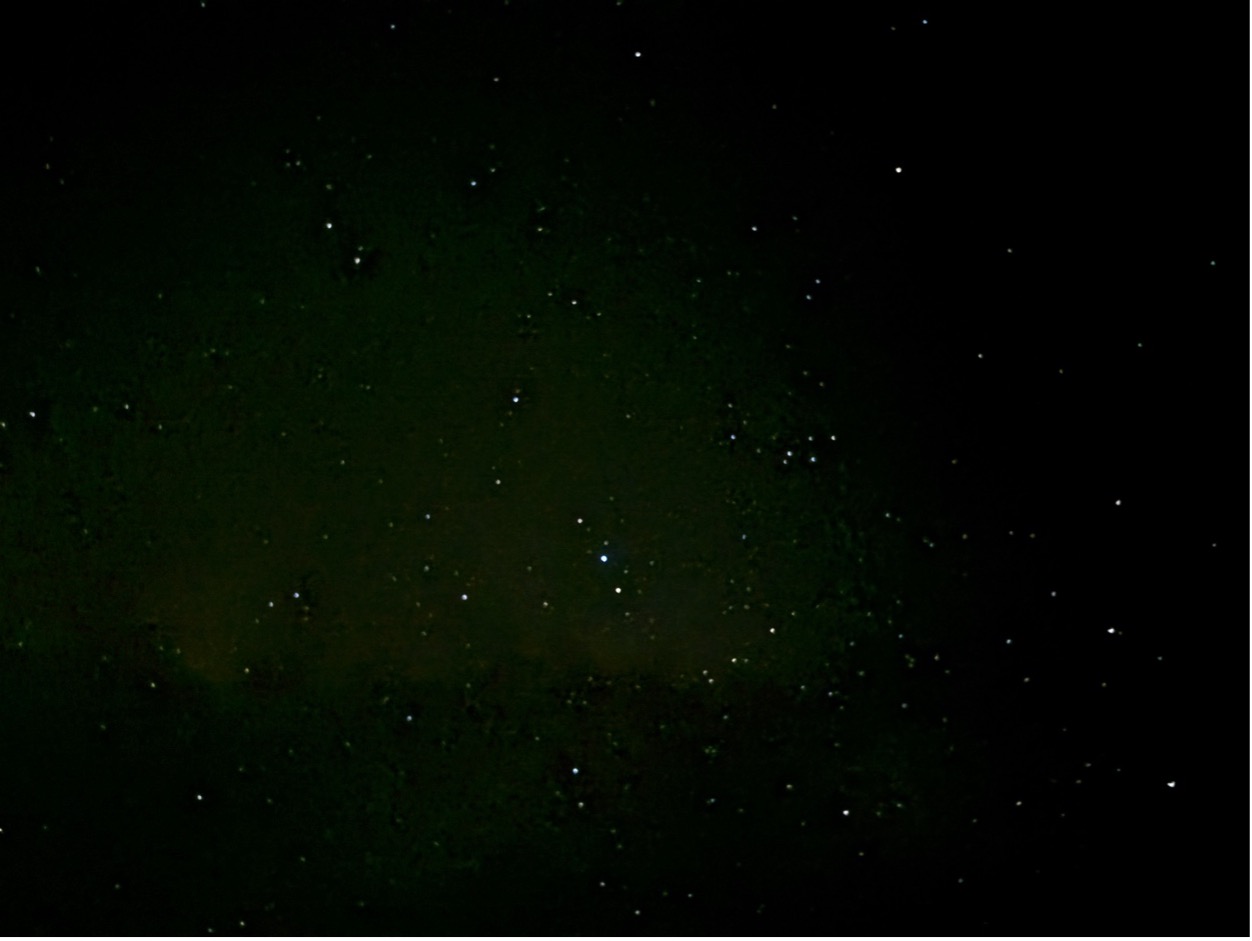

Have you ever been stargazing wondered what all those stars are made of? Stars are essentially large balls of gas, mostly made of hydrogen and helium gas. I recently went stargazing in Deerlick Astronomy Village, and I wanted to find out how we know which elements compose stars. The answer is absorption spectroscopy.
Absorption spectroscopy is a method of analysis that measures light. For any given atom, there are electrons orbiting the nucleus at specific, discrete energy levels. When electrons absorb light, they jump up to a higher energy level which is known as an excited state. This process requires a specific energy or frequency of light for each electron to cross the gap, so the information we get can be used to distinguish between elements. It’s important to remember that all atoms of the same element will absorb the same frequencies of light. Absorption spectroscopy gives us those amounts of energy in the form of wavelengths of light. Each wavelength absorbed corresponds to the energy required to excite an electron, so we can visualize these values through the visible light spectrum we see.
When looking at an absorption spectrum, you notice that there are dark lines at certain wavelengths representing the absorbed energy. Each element has its own unique absorption spectra that we can use as a guide to understand experimental data. We can also create a spectrum that is the inverse of an absorption spectrum—the emission spectrum.
When electrons drop down to their unexcited states, they release the same amount of energy that was required for them to become excited. This energy can again be measured as a wavelength of light and can be visualized with the visible light spectrum. So, in an emission spectrum, we only show the wavelengths of energy that are emitted, but in an absorption spectrum we show all wavelengths except the wavelengths that are absorbed. If you overlap the emission and absorption spectra, you get the full range of visible light.
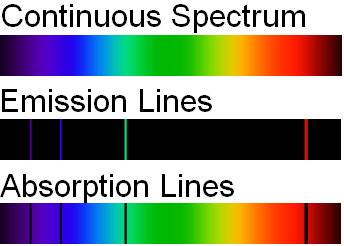
This technique of spectroscopy can be applied to understanding the elemental makeup of stars. Astronomers collect spectra through a spectroscope attached to a telescope. The telescope is positioned towards stars (bright stars work best) and the spectroscope splits the light that enters into individual wavelengths that can be analyzed as absorption spectra. The spectra collected from the spectroscopes can then be compared with known absorption spectra of each element to determine the elements that make up stars.
References:
Brewer, J. M., Fischer, D. A., Valenti, J. A., & Piskunov, N. (2016). SPECTRAL PROPERTIES OF COOL STARS: EXTENDED ABUNDANCE ANALYSIS OF 1,617 PLANET-SEARCH STARS. The Astrophysical Journal Supplement Series, 225(2), 32. https://doi.org/10.3847/0067-0049/225/2/32
Spectroscopy 101 – How Absorption and Emission Spectra Work—NASA Science. (2025, September 1). https://science.nasa.gov/mission/webb/science-overview/science-explainers/spectroscopy-101-how-absorption-and-emission-spectra-work/
