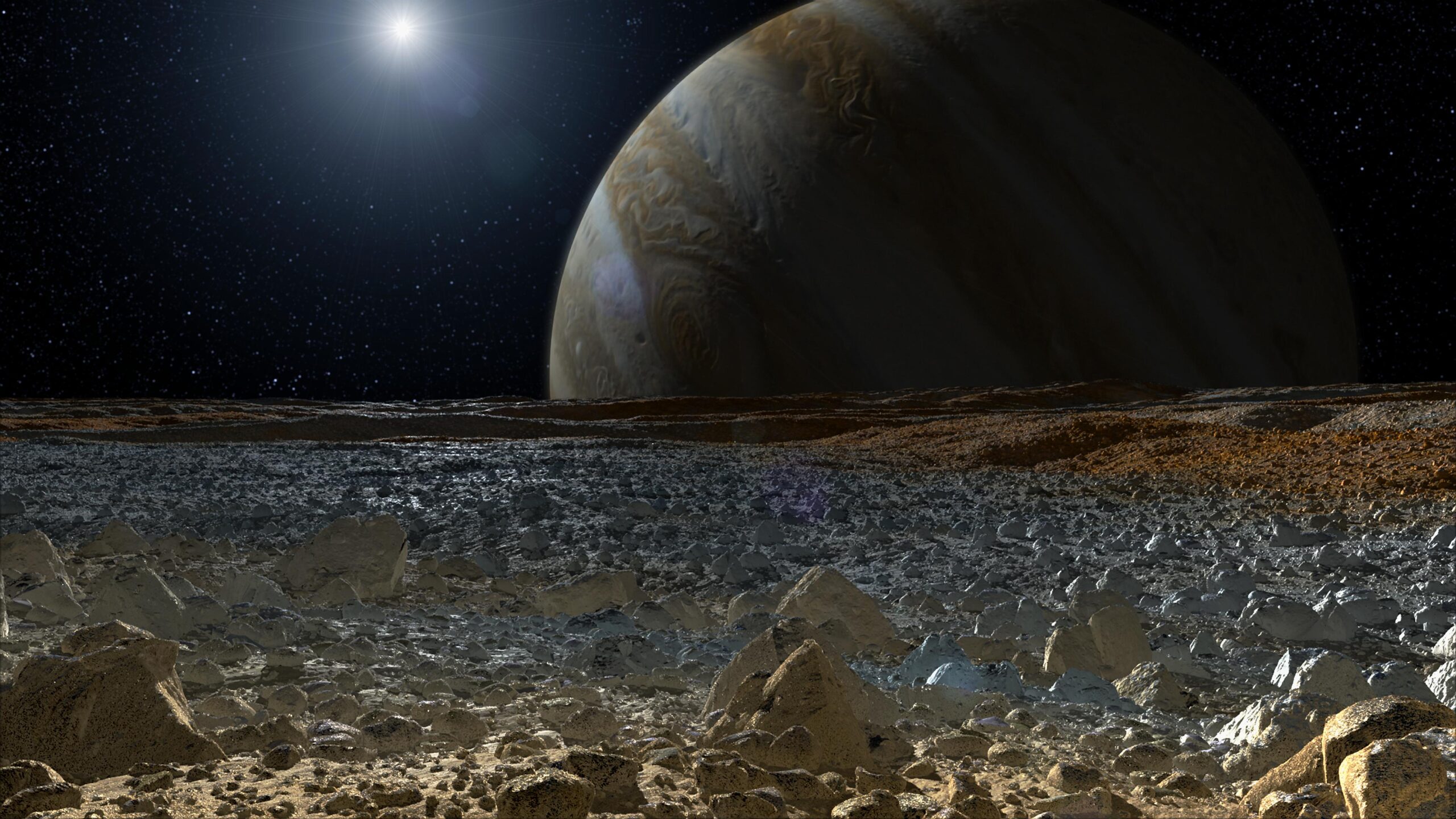
As Europa Clipper is poised to make its flyby of Earth in December 2026 (next month!), it’s the perfect time to highlight its mission and larger purpose: to search for potential life outside Earth, and specifically Europa. One of Jupiter’s many moons, Europa has become one of the most promising places to search for life within the solar system. Thus, on October 14, 2024, NASA launched its largest ever spacecraft for a planetary mission, Europa Clipper, to do just that (Europa Clipper Mission Timeline, n.d.; Europa Clipper Mission Overview, n.d.).
Why Europa?
	In 2000, a paper published by Kivelson et. al. (2000) solidified a peculiar finding: Europa may have a subsurface ocean! Using magnetic field measurements from the Galileo spacecraft, which made a flyby of Europa, Kivelson et. al. were able to confirm that Europa contained a magnetic field induced by Jupiter’s magnetic field; in other words, Jupiter’s changing magnetic fields created a reaction in Europa that caused it to create its own magnetic field. In order for Europa to do so, its subsurface had to be made of an electrical conductor, or something that can move electricity around. The most likely candidate, the researchers concluded, was liquid water. Scientists consider liquid water one of the most important ingredients for life, so the fact that Europa potentially contains liquid water is a big factor in its potential hospitality of life.

	Europa also contains many key elements necessary for life, such as nitrogen, carbon, sulfur, and phosphorus (Why Europa: Ingredients for Life, n.d.). Most recently, the James Webb Telescope in 2023 also discovered carbon dioxide on the surface of some of the youngest regions on Europa, which suggests that the source of the carbon dioxide may actually originate from inside Europa rather than outside (Trumbo and Brown, 2023). Why does this matter? Carbon is an element that is seen as a strong candidate for the basis of lifeforms. After all, carbon is the basis for life on the one place we know for sure life exists, Earth. Thus, the fact that Europa may be producing its own carbon strengthens the possibility that life exists on the icy moon.

	While life on Earth gets all of its energy from the Sun, life on Europa would not be able to do the same, as radiation on the moon renders its surface uninhabitable. However, the reason that Europa’s surface is uninhabitable may also be the very reason why the moon has potential for life. The radiation that Europa receives has the potential to transform water in its atmosphere into molecular oxygen, O2. Oxygen, being a very reactive element, could then react with other molecules on Europa’s surface to release energy, which can then be transferred into its ocean, where it can be used by life (Cowen, 2000).
What’s next?
With all the necessary ingredients for life, Europa has become one of the main focuses in our search for extraterrestrial life. Europa Clipper is set to reach Jupiter in April of 2030 and conduct its first flyby of Europa in Spring of 2031, after which it will conduct a total of nearly 50 more flybys of Europa by September 2034 (Europa Clipper Mission Timeline, n.d.). In this period, Europa Clipper will collect imagery, thermal data, atmospheric composition, and more (Europa Clipper Mission Overview, n.d.). This data will undoubtedly provide invaluable data and insight in our search for life, regardless of whether or not life is found; ultimately, it will move us one step closer to a greater understanding of our place in the universe.
References
Cowen, R. (2000, January 9). Life on Europa: A possible energy source. Science News. https://www.sciencenews.org/article/life-europa-possible-energy-source

Europa Clipper Mission Overview. (n.d.). NASA Science. Retrieved November 8, 2026, from https://science.nasa.gov/mission/europa-clipper/mission-overview/

Europa Clipper Mission Timeline. (n.d.). NASA Science. Retrieved November 8, 2026, from https://science.nasa.gov/mission/europa-clipper/mission-timeline/

Kivelson, M. G., Khurana, K. K., Russell, C. T., Volwerk, M., Walker, R. J., & Zimmer, C. (2000). Galileo Magnetometer Measurements: A Stronger Case for a Subsurface Ocean at Europa. Science, 289(5483), 1340–1343. https://doi.org/10.1126/science.289.5483.1340

Simulated View from Europa’s Surface (Artist’s Concept). (2013). In NASA Science. NASA/JPL-Caltech. https://science.nasa.gov/resource/simulated-view-from-europas-surface-artists-concept/

Trumbo, S. K., & Brown, M. E. (2023). The distribution of CO2 on Europa indicates an internal source of carbon. Science, 381(6664), 1308–1311. https://doi.org/10.1126/science.adg4155

Why Europa: Ingredients for Life. (n.d.). NASA Science. Retrieved November 8, 2026, from https://science.nasa.gov/mission/europa-clipper/why-europa-ingredients-for-life/